What Is an MES? Functions, ISA-95 and How to Select One
A manufacturing execution system (MES) is the layer of software that runs and records production on the shop floor: which order runs where, with which materials, by whom, and with what result. This guide explains what an MES covers, where it sits in the ISA-95 model, how it differs from ERP and from the spreadsheets many plants still use, and how to select one without buying more than you need.
What an MES does
ERP knows that 5,000 units of a product are due on Friday. The PLCs know that a filler is running at 240 bottles a minute. Between the two sits a layer that turns the plan into executed, recorded work: releasing orders to lines, checking that the right materials and people are there, collecting counts, downtime and quality results, and sending actual figures back to the business. That layer is manufacturing operations management, and the software that performs it is usually called an MES.
Typical MES functions include:
- Order dispatching and execution: sending work orders to lines or machines in sequence and tracking their status.
- Data collection: production counts, cycle times, downtime events and reasons, scrap, often directly from machines.
- Genealogy and traceability: recording which material lots, equipment and operators went into each batch or serial number.
- Quality: in-process checks, specification limits, holds and release.
- Performance analysis: OEE, losses and schedule adherence.
- Electronic work instructions and records: showing the correct procedure and capturing sign-offs.
Wikipedia's history of MES notes that the systems grew out of dedicated data-collection tools; during the 1990s their functions overlapped, and the Manufacturing Enterprise Solutions Association (MESA) introduced some structure by defining 11 functions that set the scope of MES.
Where MES sits: the ISA-95 model
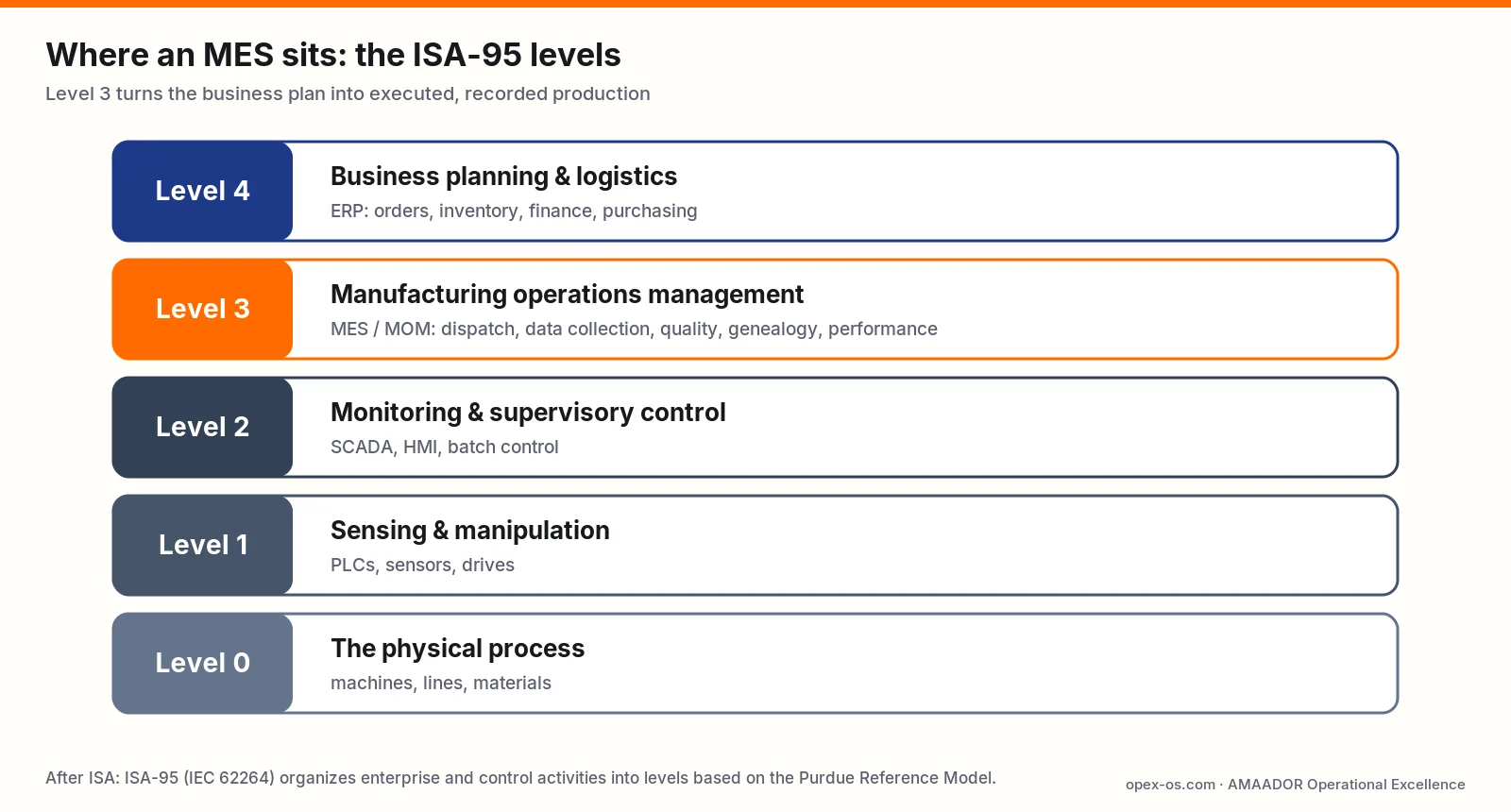
The International Society of Automation (ISA) describes ISA-95, also known as ANSI/ISA-95 or IEC 62264, as an international set of standards for integrating enterprise and control systems. It organizes technology and business processes into layers by the activities that take place, building on the Purdue Reference Model. Level 4 is business planning and logistics (ERP). Level 3 is manufacturing operations management, the home of MES. Levels 2, 1 and 0 are control systems, sensing and the physical process.
ISA-95 Part 2 specifies the information exchanged between level 3 manufacturing systems and level 4 business systems, with the stated goal of reducing the risk, cost and errors of implementing that interface. Part 3 defines activity models of manufacturing operations management. According to Wikipedia's summary, the 2005 publication of Part 3 divided level 3 activities into four main areas: production, quality, logistics (inventory) and maintenance. ISA lists Part 1 (models and terminology) in a 2025 edition, so the standard is still being maintained.
Why this matters to buyers: ISA-95 gives you a vendor-neutral vocabulary. If a proposal cannot say which level 3 activities it covers and what it exchanges with your ERP, you will discover the gaps during implementation.
MES vs ERP vs spreadsheets
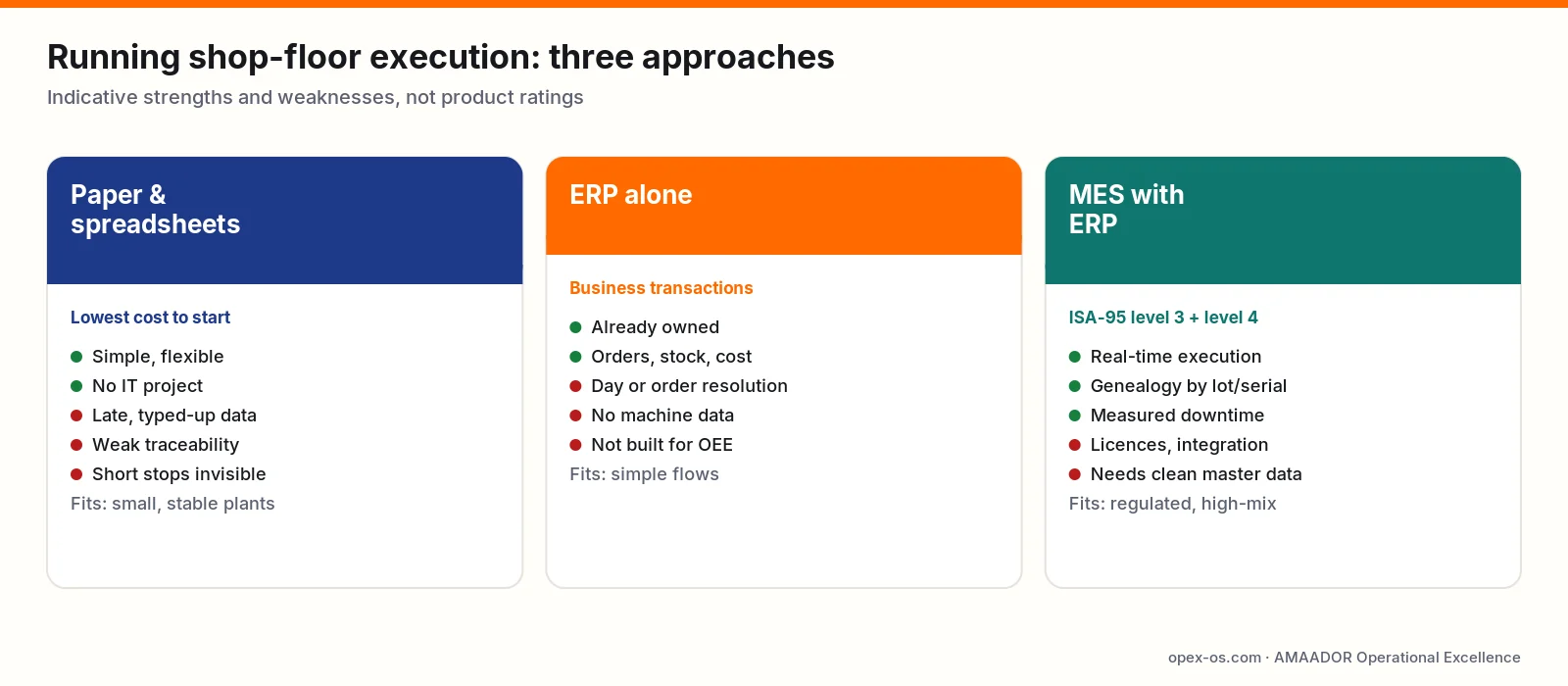
| Question | Paper and spreadsheets | ERP alone | MES (with ERP) |
|---|---|---|---|
| Time resolution | Shift or day, typed later | Order or day | Seconds to minutes, as it happens |
| Machine data | Manual | Rarely | Direct from PLCs or edge devices |
| Traceability | Hard to rebuild after a complaint | Lot level, often at receipt and shipment | Lot or serial level through each step |
| Downtime and OEE | Estimated, prone to gaps | Not designed for it | Measured, with reason codes |
| Cost and effort | Lowest to start | Already owned | Licences, integration and change management |
| Best fit | Small, simple, stable processes | Business transactions | Regulated, high-mix or high-volume operations |
Indicative comparison of approaches, not of specific products.
Spreadsheets are not wrong. A small plant with one line and stable products can run well on paper, a whiteboard and a weekly spreadsheet. The case for an MES grows with product mix, regulatory traceability, the number of lines and the cost of a lost hour.
Selection criteria that matter
- Start from use cases, not modules. Write the five decisions the system must improve (for example "release the right order to line 3", "prove which lot went to which customer within one hour"). Score vendors on those.
- ISA-95 coverage. Which level 3 activities (production, quality, inventory, maintenance) are native, and which need other systems?
- Integration. Standard connectors to your ERP and to your machines (for example OPC UA or MQTT), and who owns the interface.
- Configurability. Can your engineers change screens, routings and checks without vendor change requests?
- Deployment model. On premises, cloud or hybrid; how it behaves if the network drops; where the data lives.
- Validation and records. In regulated industries, audit trails, electronic signatures and validation support.
- Total cost of ownership. Licences, hardware, integration, training and internal support over five years, compared with the value of the losses you will remove.
Pros and cons
Pros: real-time visibility, accurate OEE and downtime data, faster traceability, fewer paperwork errors, and a single version of what happened on each shift.
Cons: a large implementation effort, risk of digitizing a poor process, dependence on master data quality, and ongoing ownership costs. A common failure pattern is a system that records everything but changes nothing because nobody reviews the data in daily meetings.
How to start
Begin with one line and one or two use cases, usually downtime capture and order tracking. Measure the baseline first with simple tools, such as an OEE calculator or a schedule adherence check, so you can prove the benefit later. Clean the equipment list and master data before go-live; the Asset List Cleaner helps with the asset side. Then put the new data into the existing tiered daily meetings so it drives action.
Common mistakes
- Choosing the platform before agreeing the use cases and owners.
- Trying to roll out every module to every line in one project.
- Collecting dozens of downtime reasons that nobody analyses. Start with ten and refine.
- Leaving operators out of screen design, then blaming them for poor data.
- Forgetting that people still need standard work. Software supports a process, it does not replace it.
MES, MOM and newer architectures
You will also see the terms manufacturing operations management (MOM), which is the broader ISA-95 level 3 scope, and "composable" or app-based MES, where plants assemble smaller applications on a shared data layer instead of buying one monolithic suite. The trade-off is flexibility against integration effort and governance. Whichever architecture you choose, the ISA-95 questions stay the same: which activities are covered, what data moves between levels, and who owns each interface.
Related free tools
Sources and further reading
- ISA: ISA-95 Series of Standards, Enterprise-Control System Integration
- Wikipedia: Manufacturing execution system (history, MESA functions, ISA-95)
Frequently asked questions
Is an MES the same as a SCADA system?
Do small manufacturers need an MES?
How long does an MES implementation take?
What is ISA-95 used for in an MES project?
Put it into practice
Free calculators and procedure generators for maintenance, reliability and continuous-improvement teams.
Explore the free tools →