Tiered Daily Meetings: How Tier 1, 2 and 3 Work
Tiered daily meetings connect the shop floor to plant leadership every day. Each tier holds a short, standing meeting at a board, deals with what it can, and escalates what it cannot to the next tier, so a problem raised at 7 a.m. on the line can reach someone with authority to fix it before lunch. This guide explains the tiers, agendas, boards and escalation rules.
What tiered meetings are
A tiered meeting (or tiered huddle) system is a cascade of short, daily, standing meetings at visual boards. Each level reviews performance against targets for the last day and the day ahead, deals with the problems it can solve, and escalates the rest. It is a core element of what is often called lean daily management, alongside visual controls and leader standard work.
The Lean Enterprise Institute describes visual management as placing tools, parts, production activities and performance indicators in plain view so that the status of the system can be understood at a glance by everyone involved. Tier boards apply that idea to daily performance and problems.
The three tiers
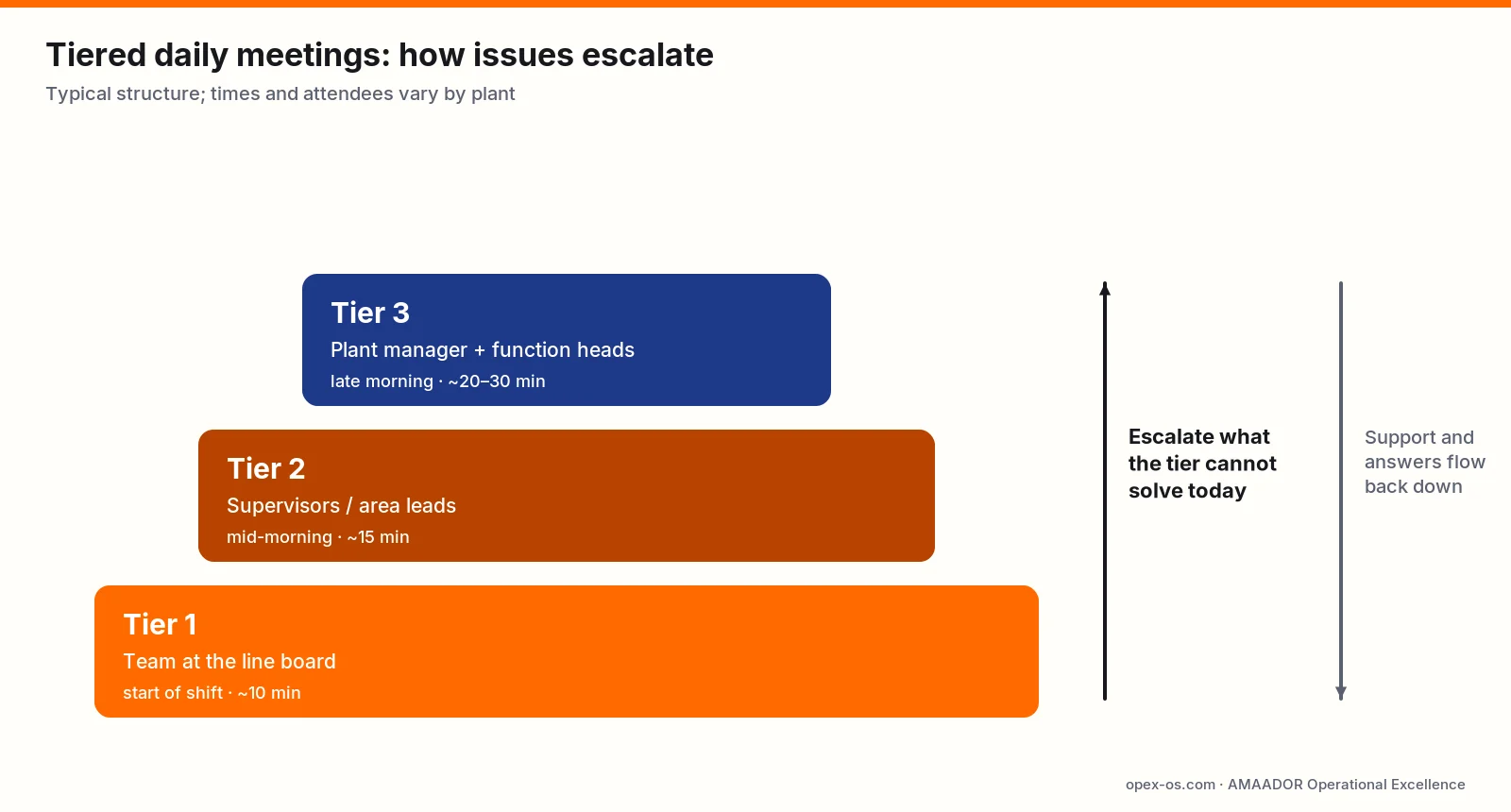
Exact names, times and attendees vary between sites; a common structure is:
| Tier | Who | Typical timing | Focus |
|---|---|---|---|
| Tier 1 | Team leader and operators | Start of shift, about 10 minutes | Yesterday's results, today's plan, safety, problems at the line |
| Tier 2 | Supervisors, area leads, maintenance and quality support | After Tier 1, about 15 minutes | Issues escalated from Tier 1, cross-team problems, resources |
| Tier 3 | Plant manager and function heads | After Tier 2, about 20 to 30 minutes | Plant-level performance, issues needing senior decisions or other sites |
Some organisations add a Tier 4 at business or regional level. The important point is the sequence: each tier meets after the one below it, so escalated issues arrive the same morning.
The Tier 1 board
A Tier 1 board is usually organised around SQDC: Safety, Quality, Delivery and Cost, sometimes with People or Morale added. For each, it shows the target, yesterday's result (often green or red), and a short list of problems with an owner and a due date.
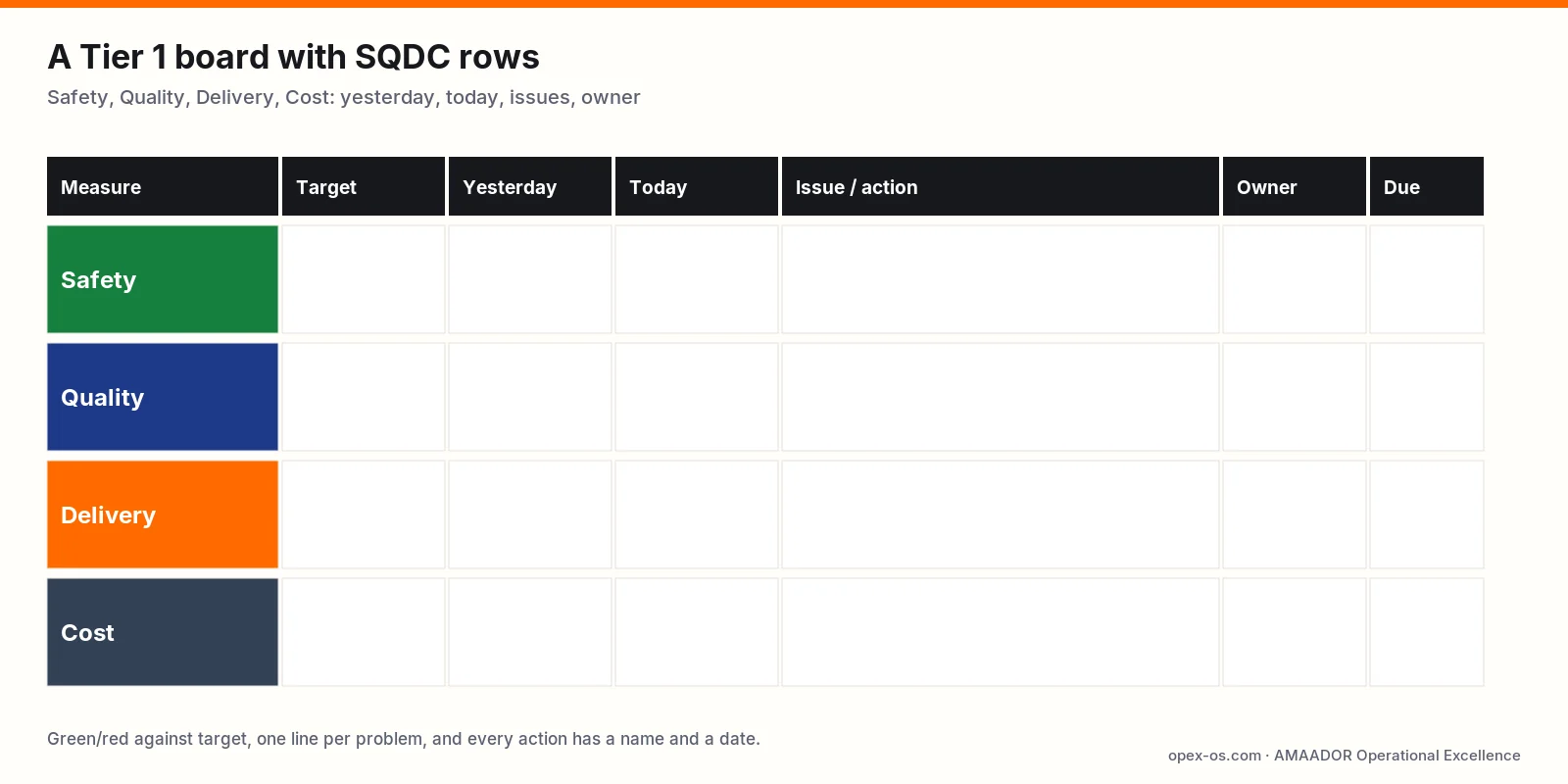
The free Start-of-shift huddle (Tier 1) tool gives you an agenda and board template; the Visual Management Board tool helps lay out the board itself.
A standard agenda
Keep the agenda identical every day so the meeting runs itself:
- Safety: any incidents or near misses since the last meeting; today's hazards.
- Quality: defects, complaints, holds.
- Delivery: yesterday's output versus plan; today's plan and constraints.
- Cost: scrap, overtime, downtime.
- Problems and actions: review open actions, add new ones, decide what to escalate.
Stand at the board, start on time, and finish on time. Problem-solving happens after the meeting with the right people, not during it.
Escalation rules
Escalation is what makes tiers more than a set of separate meetings. Agree simple rules, for example:
- Escalate when the team cannot solve the problem itself, or cannot solve it within an agreed time.
- Escalate anything involving safety, customer impact or another department immediately.
- Every escalated item gets an owner at the receiving tier and an answer back to the tier that raised it.
The free Tier 2 meeting and Tier 3 plant review tools give matching agendas so items move cleanly from one level to the next.
Example Tier 2 and Tier 3 agendas
Tier 2 usually covers several Tier 1 teams. A simple agenda: safety issues from the morning huddles; each area's SQDC status in one sentence; escalated problems, each given an owner and an answer time; support needed today from maintenance, quality, materials or engineering; and a check on overdue actions. Support functions attend so that decisions can be made in the room.
Tier 3 looks at the plant: safety first, then plant-level SQDC, issues escalated from Tier 2 that need senior decisions or another site, and a short review of improvement projects that are behind. The plant manager's role is to remove obstacles and send answers back down the chain, not to re-run the lower meetings.
Leader standard work around the tiers
Tier meetings work best when leaders also go to the gemba. A supervisor might attend Tier 1, walk the area, then take escalations to Tier 2; a plant manager might follow Tier 3 with a short gemba walk to see one escalated problem first-hand. Writing this routine down as leader standard work, and checking it is followed, keeps the system from fading when workloads rise.
Starting small
Begin with Tier 1 in one pilot area, with a paper board and four measures. Once the team runs it reliably for a few weeks, add Tier 2 for that area, then extend to other areas. Launching every tier across a whole site on the same day tends to create meetings without the habits behind them.
Getting the data in time
Tier 1 needs yesterday's numbers before the shift starts. If the data takes hours to compile, the meeting turns into a discussion of opinions. Keep measures simple and close to the work: hand-recorded hourly output on the board is often better than a late report. If your team already reports breakdowns in WhatsApp, the paid Chat to Downtime Log kit turns an exported chat into a downtime log you can bring to the morning meeting.
Evidence beyond manufacturing
Daily huddles are not only a factory practice. The US Agency for Healthcare Research and Quality (AHRQ) lists, in its EvidenceNOW tools, a webinar on implementing team huddles in primary care practices and describes how huddles benefit communication within a care team. The format travels well beyond the factory.
Common mistakes
- Meetings that run long because problem-solving happens in the huddle.
- Boards nobody updates, so the meeting relies on memory.
- Escalations with no answer, which teaches teams not to escalate.
- Leaders who skip their tier, breaking the chain.
- Too many measures. Four to six that the team can influence beat twenty that it cannot.
Related free tools
Sources and further reading
- Lean Enterprise Institute: Visual Management
- Lean Enterprise Institute: Lean Management
- AHRQ EvidenceNOW: Guidance on Implementing Team Huddles in Primary Care
Frequently asked questions
What is a Tier 1 meeting?
What does SQDC stand for?
How long should a tier meeting last?
What gets escalated to the next tier?
Put it into practice
Free calculators and procedure generators for maintenance, reliability and continuous-improvement teams.
Explore the free tools →