Lean and Agile in Operations: A Practical Hybrid Approach
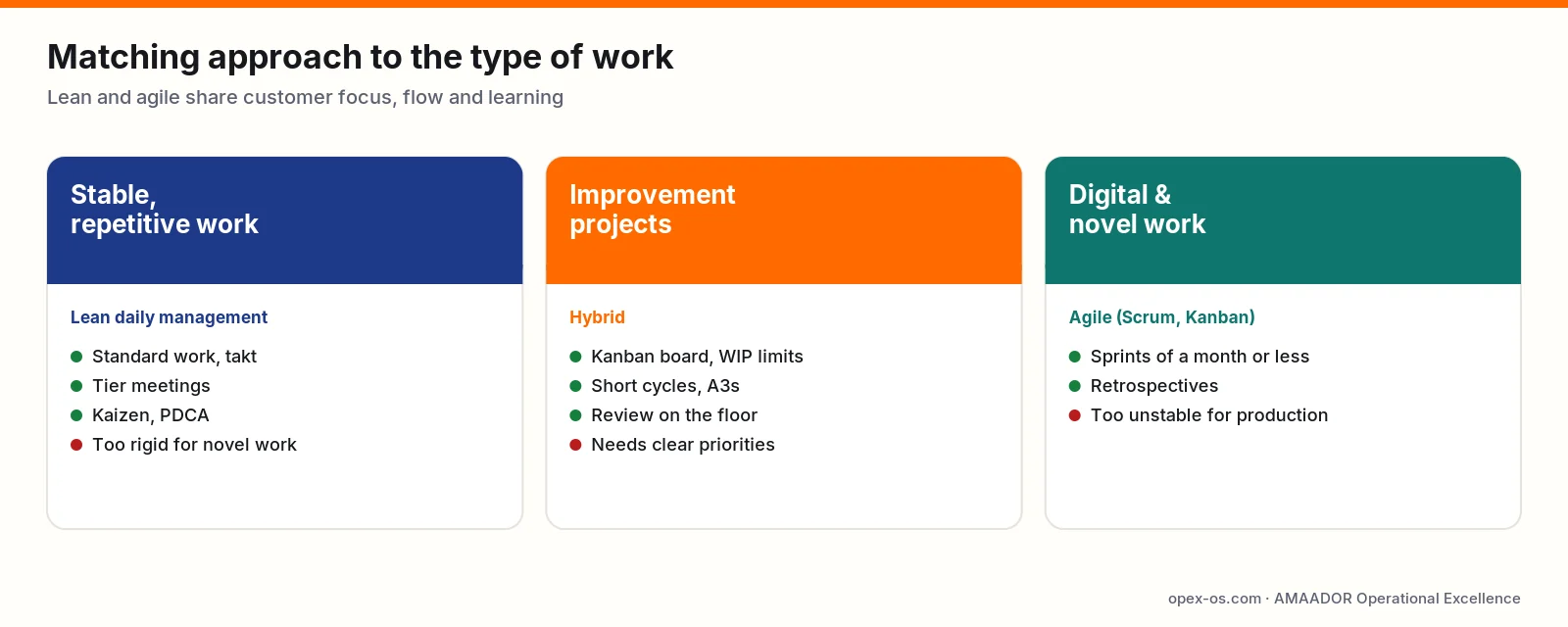
Agile methods were born in software; lean was born in manufacturing. Today many operations teams use both: lean for stable, repetitive work and daily management, agile practices for improvement projects, digital initiatives and anything uncertain. This guide compares the two, explains which practices transfer to operations, and outlines a hybrid model that avoids ceremony for its own sake.
Lean and agile in one paragraph each
Lean focuses on value for the customer, flow and the elimination of waste, built on standard work and continuous improvement. Toyota describes its production system as based on the complete elimination of waste in pursuit of the most efficient methods, resting on jidoka and just-in-time.
Agile is a set of values and practices for work with high uncertainty. The 2001 Manifesto for Agile Software Development values individuals and interactions over processes and tools, working software over comprehensive documentation, customer collaboration over contract negotiation, and responding to change over following a plan. Scrum, the best-known agile framework, is according to the Scrum Guide founded on empiricism and lean thinking, and organizes work in fixed-length Sprints of one month or less, with a 15-minute Daily Scrum to inspect progress.
Where they differ
| Aspect | Lean (operations) | Agile (Scrum and Kanban) |
|---|---|---|
| Best for | Repetitive, well-understood work | Uncertain, novel, changing work |
| Standard | Standard work is the baseline for improvement | Working increments; process adapted each Sprint |
| Rhythm | Takt time, daily tier meetings | Sprints, Daily Scrum, reviews, retrospectives |
| Planning | Levelled plans, stable schedules | Short-horizon planning, backlog re-prioritized often |
| Improvement | Kaizen, PDCA, A3 | Retrospectives, inspect and adapt |
| Risk if misapplied | Rigid standards for uncertain work | Constant change for work that should be stable |
Comparison of approaches based on the Agile Manifesto, the Scrum Guide and Toyota’s description of TPS.
Both share more than the labels suggest: customer focus, small batches, visual work, short feedback loops and respect for people. The Scrum Guide itself names lean thinking as a foundation.
Which agile practices help operations teams
- Visual Kanban boards for improvement work: columns such as idea, ready, doing, check, done, with limits on work in progress so teams finish before starting more.
- Short cycles for projects: two- to four-week cycles for digital, layout or problem-solving projects, ending with something tested on the floor.
- Backlog with clear priority: one ordered list of improvement work, owned by a leader who decides.
- Retrospectives: a short, regular review of how the team works, the agile cousin of the PDCA "check".
- Cross-functional teams: operations, maintenance, quality and IT working on one problem together.
What not to copy
- Sprints for production itself. Production runs to takt and plans, not to two-week increments.
- Changing standard work every cycle without evidence.
- Ceremonies that add meetings without decisions. If the tier meeting already covers it, do not add a Daily Scrum.
- Job titles and certifications as a goal.
A hybrid model that works
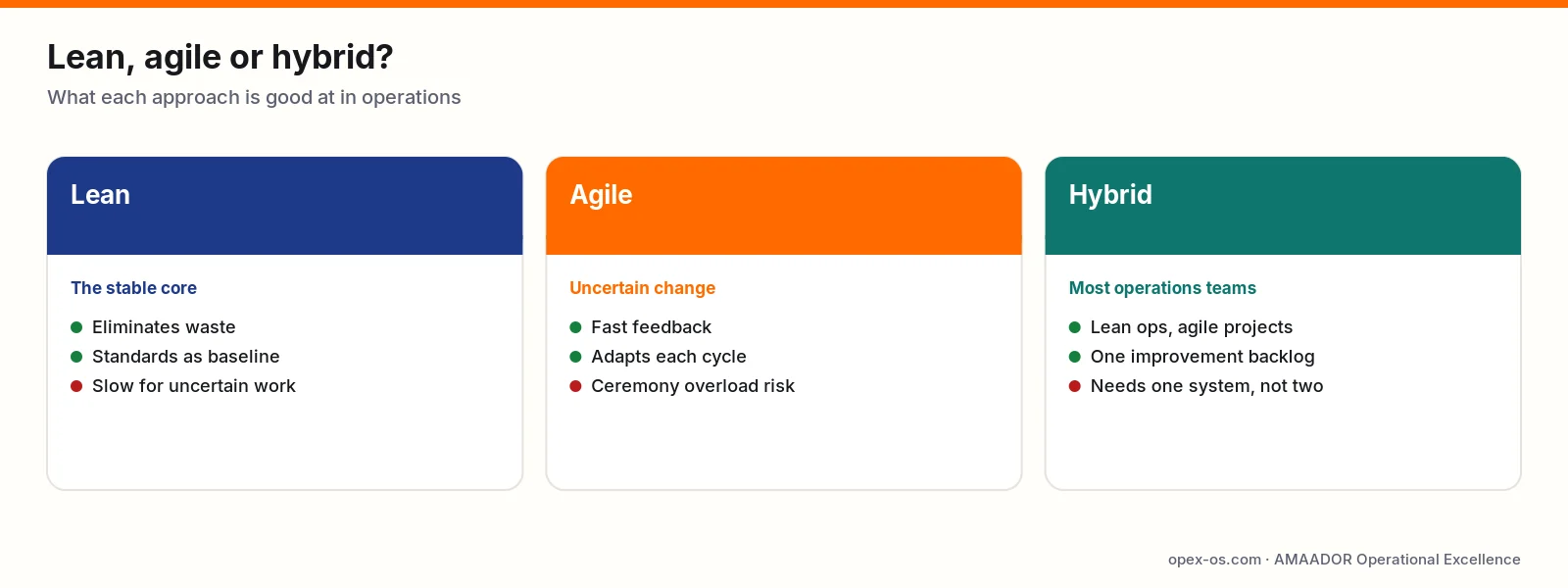
- Lean daily management for operations: standard work, hour-by-hour tracking and tiered daily meetings.
- One improvement backlog per area, fed by tier meetings, audits and ideas, prioritized weekly.
- Agile cycles for bigger improvements: a kaizen event or a two- to four-week project cycle with a clear goal and a review on the floor.
- A3 thinking for problems, keeping root cause discipline inside fast cycles.
- Quarterly alignment with strategy deployment so the backlog reflects priorities.
Selection criteria for tools
A physical board is often enough for one team. When several teams share a backlog, or you need links to tier meetings and strategy, look for tools that support Kanban boards with WIP limits, simple cycle planning, links between ideas, actions and results, and reporting on lead time from idea to done. Keep the tool lighter than the work. Our CI portfolio tracker and kaizen charter work well as a starting point.
Measures that show the hybrid works
- Lead time from idea or problem to implemented change.
- Share of improvement items finished versus started each month.
- Stability of standard work and operational KPIs after changes.
- Team engagement in improvement, for example the share of people involved in at least one change per quarter.
An example: a packaging line improvement team
Consider a plant where the packaging area runs on lean daily management: standard work, an hour-by-hour board and a tier 1 meeting each shift. Problems that cannot be solved within a day go onto a shared improvement backlog on a Kanban board, with no more than three items in progress at once. Every two weeks, the area manager, a maintenance planner and a quality engineer review the backlog, pick the next items and review what was finished on the floor. Larger problems get an A3 and a short project cycle. Every quarter, the backlog is checked against the plant's strategic priorities. Nothing in this model needs special software or agile job titles, yet it borrows the useful parts of agile: visible work, limited work in progress, short feedback cycles and regular reflection.
Roles in the hybrid
Someone must own the priority order of the improvement backlog, usually the area or value stream manager. A facilitator, often a CI engineer, keeps the board and cycles running and coaches problem-solving. Team members from operations, maintenance and quality do the work. Leaders at the next level review results and remove obstacles, as in any good tier system.
Common mistakes
- Treating agile as permission to skip standards.
- Running two parallel systems (lean meetings and agile ceremonies) that duplicate each other.
- Unlimited work in progress: dozens of open actions and few finished.
- No link between the improvement backlog and strategy.
Related free tools
Sources and further reading
- Manifesto for Agile Software Development
- The Scrum Guide (November 2020)
- Toyota: Toyota Production System
Frequently asked questions
Is agile compatible with lean?
Should production teams run Sprints?
What are the four values of the Agile Manifesto?
What is a WIP limit?
Do we need agile coaches or certified Scrum Masters in operations?
Put it into practice
Free calculators and procedure generators for maintenance, reliability and continuous-improvement teams.
Explore the free tools →