Process Mining for Operations: A Practical Guide
Every ERP, CMMS and MES records what happened and when. Process mining turns those records into a map of how work actually flows, including the loops, waits and workarounds nobody drew on the official flowchart. This guide explains the event log it needs, the three main types of process mining, the XES standard, and practical uses in maintenance, order handling and procurement.
What process mining is
The Process Mining Manifesto, written under the IEEE Task Force on Process Mining by a group of more than 75 people from more than 50 organizations, describes the idea as discovering, monitoring and improving real processes, not assumed ones, by extracting knowledge from event logs readily available in today's information systems.
That is the key difference from a workshop-drawn process map. A value stream map or swimlane chart shows how people believe the work flows. Process mining shows how the systems recorded it flowing, for every case, including the exceptions. The two complement each other: mining shows where to look, and going to the gemba explains why.
The event log
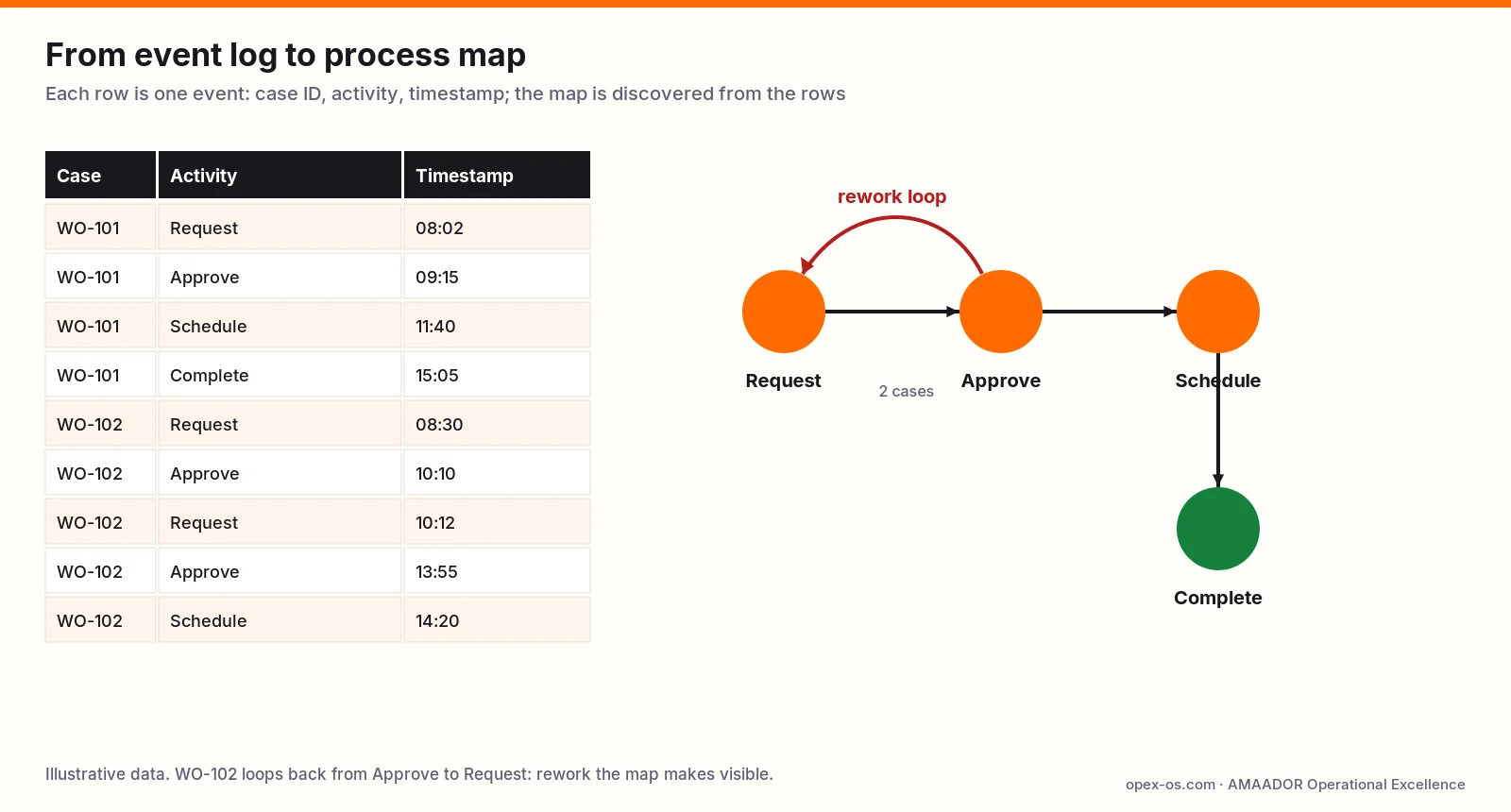
Process mining needs, at minimum, three fields for each event:
- Case ID: the thing flowing through the process (a work order, a purchase order, a customer order).
- Activity: what happened (requested, approved, scheduled, completed).
- Timestamp: when it happened.
Optional attributes such as resource, site, cost or priority allow richer analysis. The manifesto's first guiding principle is that event data should be treated as "first-class citizens", meaning trustworthy, complete and well-defined, and its second is that log extraction should be driven by questions. Decide what you want to know before you extract.
For exchanging logs between systems and tools, the IEEE publishes the XES (eXtensible Event Stream) standard. Its first revision, IEEE 1849-2023, was published in August 2023 and superseded the 2016 edition.
Three types of process mining
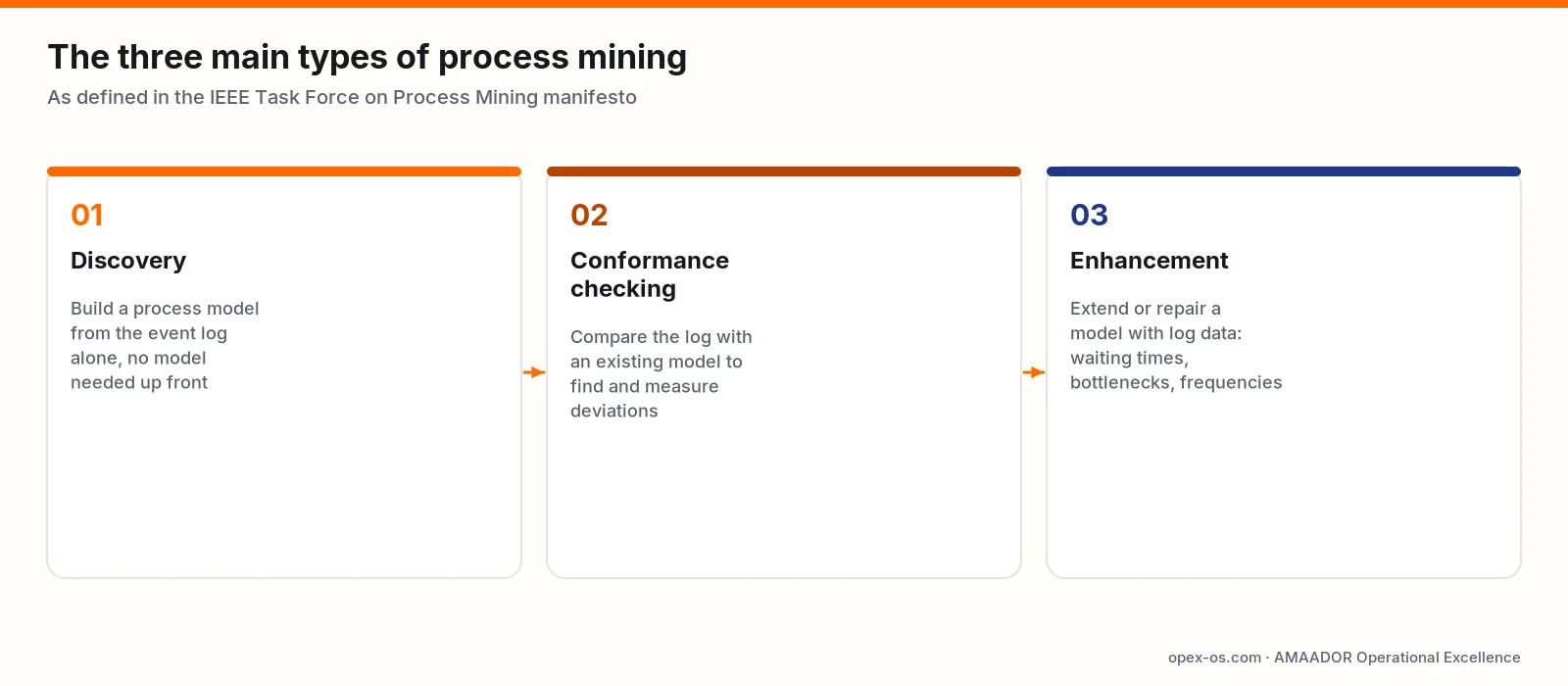
- Discovery: automatically build a process model from the event log, with no model needed in advance.
- Conformance checking: compare the log with an existing model, such as your documented procedure, to find and measure deviations.
- Enhancement: extend or improve an existing model using the log, for example by adding waiting times, frequencies and bottlenecks.
Uses in operations
Maintenance work orders
Mining CMMS data shows how work orders really move from request to closure: how many skip planning, how often they loop back for missing parts or approvals, and where they wait longest. Combined with backlog and schedule-compliance KPIs (see maintenance KPIs), it points to the specific step that slows the whole system.
Order-to-delivery
For customer orders, discovery often reveals many more variants than the official process, such as manual re-planning, credit holds and partial shipments. Conformance checking against the intended flow quantifies how often each deviation happens and how much delay it adds.
Downtime events
Process mining techniques can also be applied to machine event streams: stop, restart, call maintenance, repair started, repair finished. Many plants do not have clean downtime events at all, only messages in a chat group. The paid Chat to Downtime Log kit takes an exported WhatsApp chat and finds the stop and restart messages, giving you a basic event log to analyze.
Reading the results
A discovered process map can look overwhelming at first, because it shows every path that occurred. Useful ways in:
- Variants: list the distinct paths cases took, sorted by frequency. Often a handful of variants cover most cases, and the long tail contains the problems.
- Throughput time: compare the time from first to last event for each variant. Loops and extra approvals usually show up here.
- Waiting time between activities: long gaps point to queues, missing information or capacity limits.
- Rework loops: activities that repeat in the same case, such as a request being re-submitted after approval.
- Conformance: how often cases skip a required step or happen out of order, such as work completed before it was approved.
Process mining and lean tools together
Process mining does not replace value stream mapping, gemba walks or root cause analysis; it makes them faster and better aimed. A value stream map drawn with a team captures context that no log contains: why a step exists, what information people wait for, how they feel about the work. Mining adds what workshops miss: exact frequencies, real waiting times for every case, and the rare variants nobody remembers. A practical rhythm is to mine first to find the biggest delay or deviation, walk the process to understand it, fix it with the team, and then mine again to confirm that the change held across all cases rather than the few that were observed.
People and privacy
Event logs often contain names or user IDs. Agree with stakeholders, and where relevant with works councils or data protection staff, what will be analyzed and why. Focus findings on the process, not on individuals; mining used to judge people quickly loses the cooperation you need to fix anything. Pseudonymize resources when person-level detail is not needed.
Getting started
- Pick one process and one question, for example: "Why do urgent work orders take longer than planned?"
- Extract a sample log for a few months: case, activity, timestamp, plus one or two attributes.
- Clean it: consistent activity names, removed test records, time zones aligned.
- Discover the process and look at the most frequent variants first, then the longest waits.
- Go and see. Take the biggest finding to the people who do the work, confirm the cause, and run a focused improvement, using a value stream map or A3 as the improvement frame.
The free Value Stream Map Data Box Calculator and Loss Pareto tool are useful for turning mined waiting times and frequencies into a prioritized improvement list.
Common mistakes
- Extracting everything with no question, then drowning in spaghetti diagrams.
- Trusting dirty data: back-dated entries and batch closures distort waiting times.
- Treating the map as the answer: the manifesto calls models purposeful abstractions of reality; causes still need to be confirmed at the gemba.
- One-off analysis: the manifesto's sixth principle is that process mining should be a continuous process.
Related free tools
Sources and further reading
Frequently asked questions
What is process mining?
What data does process mining need?
What are the three types of process mining?
What is the XES standard?
Put it into practice
Free calculators and procedure generators for maintenance, reliability and continuous-improvement teams.
Explore the free tools →