Hoshin Kanri Software vs Spreadsheets and Paper X-Matrices
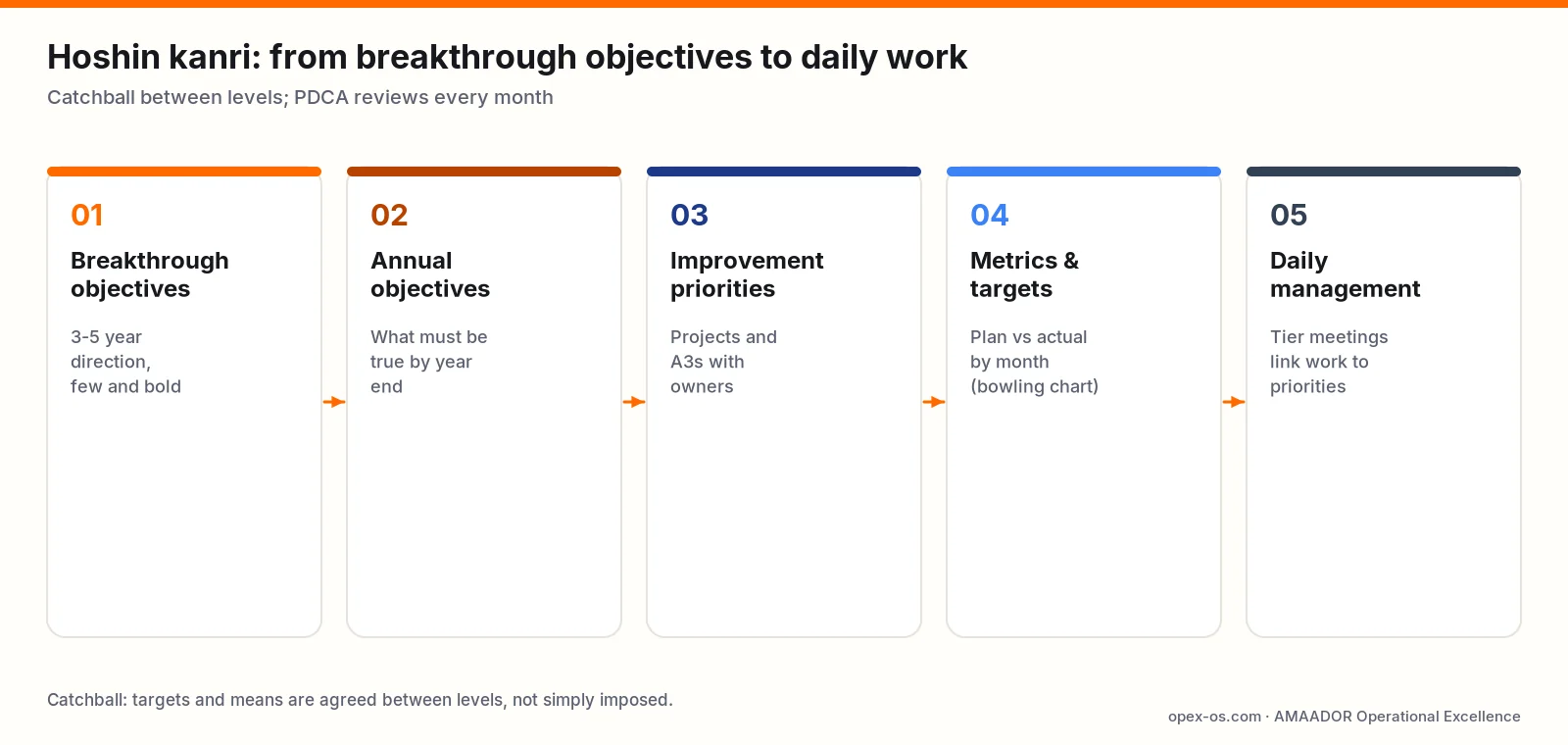
Hoshin kanri, or strategy deployment, connects a few breakthrough objectives to the daily work of every team. Many organizations start with a paper X-matrix and a spreadsheet; others buy dedicated strategy deployment software. The tool matters less than the thinking, but the wrong tool can bury that thinking in admin. This guide compares the options and sets out how to choose.
What hoshin kanri is
The Lean Enterprise Institute (LEI) describes hoshin kanri, also called policy deployment, as a strategic framework for building sustained high performance through structured plan-do-check-act (PDCA) thinking. It helps organizations define a structure and standards for setting and executing strategic initiatives, and aligns functions and activities with strategic objectives vertically and horizontally, from the CEO to the front line and across departments, so every team member understands how their role contributes.
LEI also highlights the link with A3 problem-solving: individuals at each level use A3s to identify and solve problems based on the priorities set through hoshin kanri. Its guide cites five myths of strategy execution from a 2015 Harvard Business Review article, including the beliefs that execution equals alignment and that communication equals understanding.
The core artefacts
- X-matrix: a one-page view linking long-term breakthrough objectives, annual objectives, top improvement priorities, metrics and owners. Our free X-matrix generator builds one.
- Catchball: the back-and-forth between levels to agree targets and means, rather than imposing them.
- Action plans and A3s for each priority.
- Bowling charts or monthly review sheets showing plan versus actual by month, with countermeasures where red.
Paper vs spreadsheets vs software
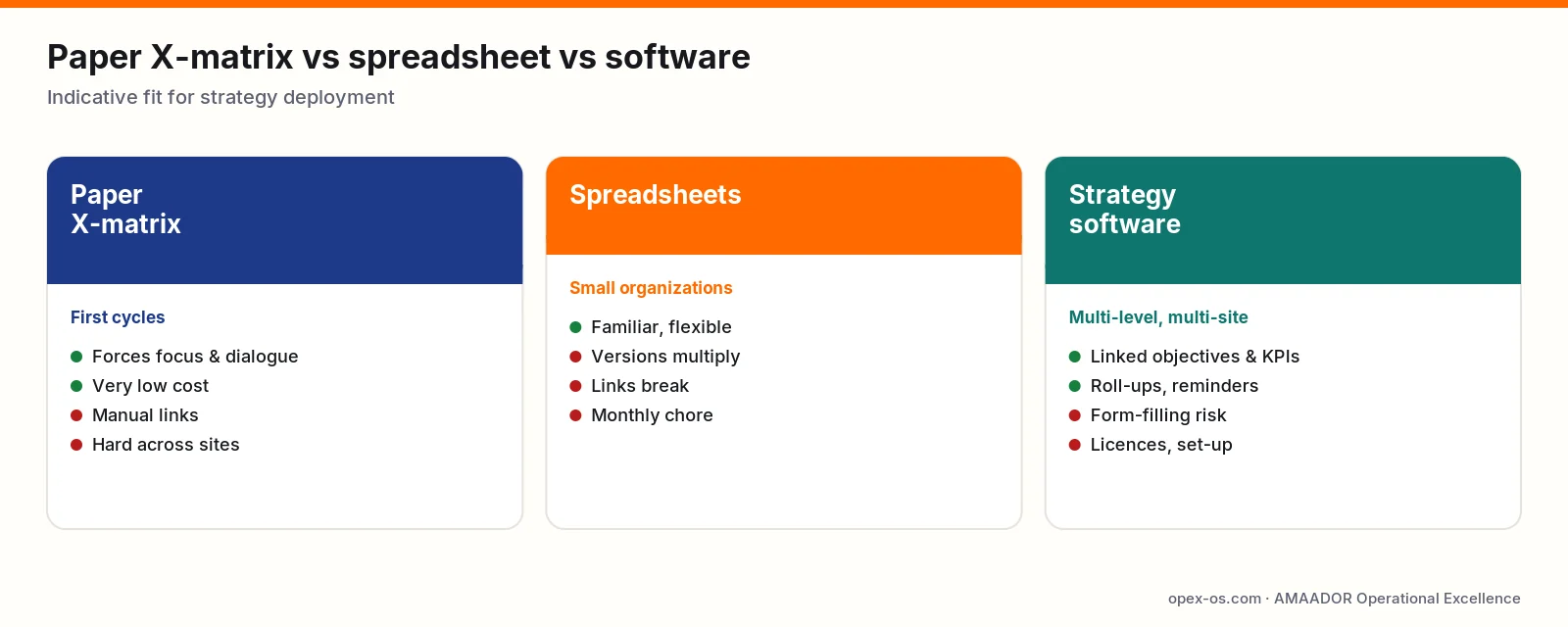
| Criterion | Paper X-matrix and wall | Spreadsheets | Strategy deployment software |
|---|---|---|---|
| Thinking and discussion | Strong: the team builds it together | Medium | Depends on use; risk of form-filling |
| Links across levels | Manual | Fragile links between files | Built in: objectives to projects to KPIs |
| Monthly reviews | Printed bowling charts | Manual updates | Automatic roll-ups, reminders |
| Visibility across sites | Poor | Shared drive | Good, with permissions |
| Cost and set-up | Very low | Low | Licences and configuration |
| Best fit | First cycles, one site | Small organizations | Multi-level, multi-site deployments |
Indicative comparison of approaches, not of specific products.
Pros and cons
Paper keeps the focus on dialogue and choice. Building an X-matrix on a wall forces leaders to choose a few priorities. It breaks down when several levels and sites must stay linked and updated.
Spreadsheets are flexible and familiar but fragile: versions multiply, links break, and monthly updates become a reporting chore.
Software maintains links between objectives, projects, owners and metrics, rolls up status and sends reminders. The risk is turning strategy deployment into a reporting system, with hundreds of initiatives and colourful dashboards but little catchball or problem-solving.
Selection criteria
- Supports the method, not just OKR lists: X-matrix, catchball comments, bowling charts and A3s.
- Few priorities by design: the tool should make it obvious when a team has too many.
- Links to daily management: priorities should connect to tier meetings and KPIs.
- Data feeds: metrics updated from source systems where possible.
- Simple monthly review: plan versus actual and countermeasures on one screen.
- Permissions and visibility across sites and functions.
- Cost and adoption effort for leaders who will use it a few times a month.
The review rhythm matters more than the tool
Hoshin kanri is PDCA at the strategic level. A typical rhythm is an annual planning cycle with catchball, monthly reviews of each priority with plan versus actual and countermeasures, and quarterly reflection on whether the strategy itself still holds. Link the monthly review to the obeya or leadership board, and connect improvement work to the annual CI plan. Check the size of gaps with the target gap tool before committing to targets.
Questions to ask vendors
- Show an X-matrix for our three objectives and how a department's priorities link to it.
- How does catchball work in the tool: comments, proposals, approvals?
- How is a red metric linked to a countermeasure or A3?
- Can metrics update automatically from our systems?
- What does a leader need to do each month, and how long does it take?
Cost and value
A paper X-matrix costs a few hours of leadership time and a wall. Software adds licences, configuration and training, and leaders must change how they prepare reviews. The value comes from three places: less time spent building monthly slide packs, fewer priorities that quietly disappear between reviews, and faster escalation when a metric turns red. A useful test before buying is to count how many hours the organization spends each month collecting status updates and reconciling spreadsheets. If that number runs into days across many teams, software will pay back; if it is a few hours, improve the review meeting first.
A first-year roadmap
- Months 1 to 2: agree breakthrough and annual objectives with the leadership team; build the top-level X-matrix.
- Months 2 to 3: catchball with department heads; each builds a linked X-matrix or priority list with owners and metrics.
- Months 3 to 12: monthly reviews with bowling charts and countermeasures; A3s for persistent reds.
- Month 12: reflect on results and on the process itself, then plan the next cycle and decide what to digitize.
Common mistakes
- Too many priorities. If everything is a priority, nothing is.
- Cascading targets without catchball, so teams do not own them.
- Monthly reviews that report status instead of solving problems.
- Buying software before running one full cycle on paper.
- Disconnecting strategy deployment from daily management.
How to start
Run your first cycle with a paper or simple digital X-matrix, using the Hoshin X-Matrix kit. Limit breakthrough objectives to a handful, agree owners, and hold monthly reviews for a year. Then decide what the software must do, based on where the manual process hurt.
Related free tools
Sources and further reading
- Lean Enterprise Institute: Hoshin Kanri
- Harvard Business Review (2015): Why Strategy Execution Unravels, and What to Do About It
Frequently asked questions
What is hoshin kanri?
What is an X-matrix?
Is hoshin kanri the same as OKRs?
Do we need software for hoshin kanri?
Put it into practice
Free calculators and procedure generators for maintenance, reliability and continuous-improvement teams.
Explore the free tools →