Digital Product Passports: What Manufacturers Need to Prepare
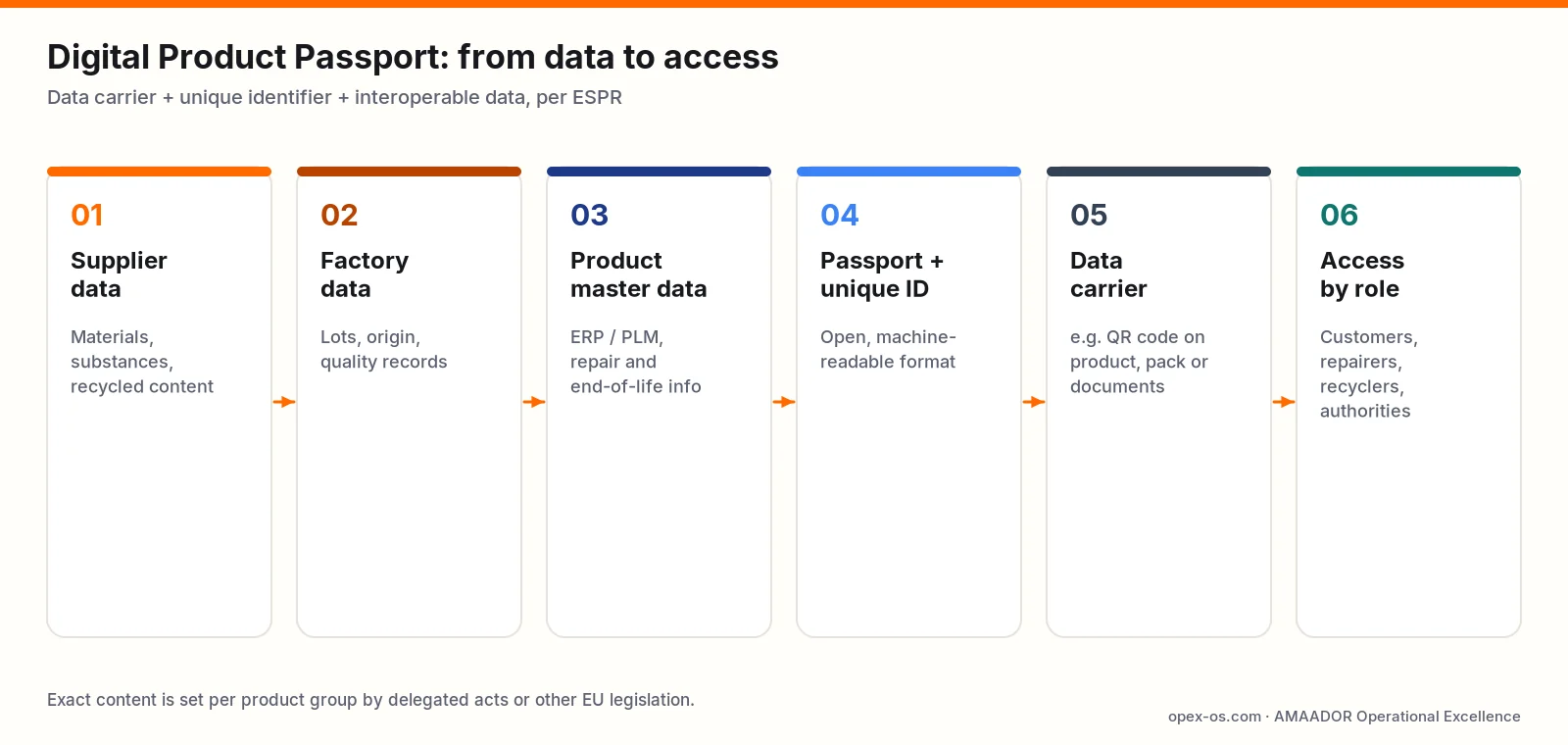
The EU Digital Product Passport (DPP) will give products a digital record that customers, repairers, recyclers and authorities can read through a data carrier such as a QR code. For manufacturers it is less a labelling task than a data task: product, material and process information that today sits in ERP, PLM, quality and supplier files. This guide sets out what is known, what is still being defined, and how to compare the ways of producing a passport.
What a Digital Product Passport is
The legal basis is the Ecodesign for Sustainable Products Regulation (ESPR), Regulation (EU) 2024/1781, adopted on 13 June 2024 and published in the Official Journal on 28 June 2024. It defines a digital product passport as a set of data specific to a product, including the information set in the applicable delegated act, accessible electronically through a data carrier. The European Commission describes the DPP as a digital container for products, components and materials that supports sustainability, circularity and legal compliance.
The regulation sets essential requirements. The passport must be connected through a data carrier to a persistent unique product identifier; the data carrier must be physically present on the product, its packaging or accompanying documentation; the data must be based on open standards, interoperable, machine-readable and transferable without vendor lock-in; and customer personal data must not be stored without explicit consent. Depending on the delegated act, the data refers to the product model, batch or individual item.
The timeline as published by the Commission
Product-specific requirements come through delegated acts under the ESPR or through other EU legislation. The Commission's DPP page lists indicative timing: iron and steel in 2026, energy-related products from 2026 to 2029, textiles, tyres and aluminium in 2027, furniture in 2028, and mattresses and ICT products in 2029, and notes that operators will have a transition period of at least 18 months after a delegated act is adopted. The ESPR required the Commission to set up a DPP registry storing at least the unique identifiers by 19 July 2026.
Batteries come first through the Batteries Regulation (EU) 2023/1542: from 18 February 2027, each light means of transport battery, each industrial battery with a capacity above 2 kWh and each electric vehicle battery placed on the market or put into service must have an electronic battery passport. Timelines are indicative and can move, so track the delegated act for your product group.
What it means for operations
Expect to provide data such as product identification, materials and substances, recycled content, origin, repair and maintenance information, and end-of-life instructions, with the exact list set per product group. Much of this depends on suppliers. Batch- or item-level passports also need traceability on the shop floor: which material lot went into which product. That is why DPP projects quickly involve quality, production and purchasing, not just marketing.
Ways to produce passports
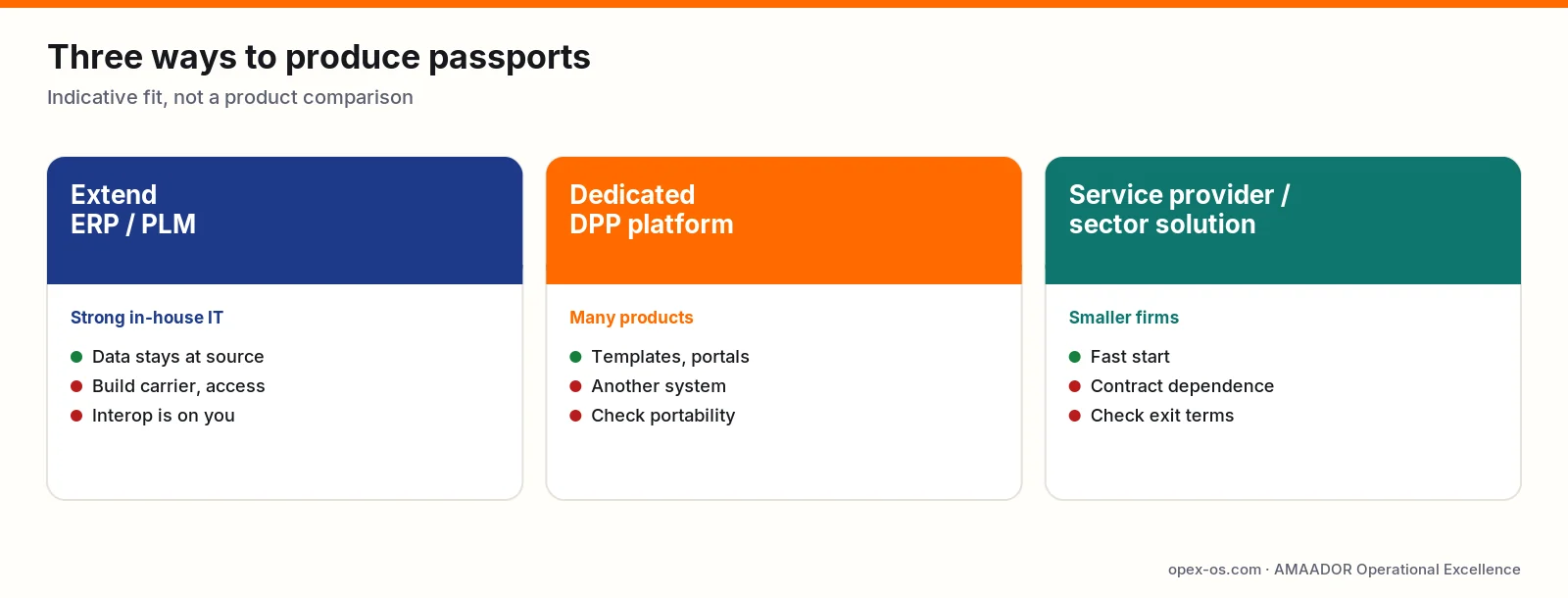
| Criterion | Extend ERP / PLM | Dedicated DPP platform | Service provider or industry solution |
|---|---|---|---|
| Best fit | Strong in-house IT, few product groups | Many products, frequent updates | Smaller firms, sector schemes |
| Data ownership | Fully internal | Shared with the platform | Depends on contract |
| Data carrier and resolver | Must be built or bought | Usually included | Included |
| Supplier data collection | Custom portals | Often built in | Often built in |
| Interoperability with EU standards | Your responsibility | Vendor roadmap dependent | Provider roadmap dependent |
| Lock-in risk | Low | Check export and identifier portability | Check export and identifier portability |
Indicative comparison of approaches, not of specific products.
Pros and cons
Extending ERP or PLM keeps data where it is mastered and avoids duplication, but requires effort to build data carriers, public access, access rights and interoperability. Dedicated DPP platforms bring ready templates, supplier portals and hosting, but add another system that must stay synchronized with product master data. Service providers and sector solutions lower the entry barrier but need careful contract terms on data ownership, identifier persistence and exit. Because the regulation demands transfer without vendor lock-in, ask every option how passports and identifiers survive a change of provider.
Selection criteria
- Granularity: model, batch and item-level support, depending on your product group.
- Identifiers and data carriers: support for the standards referenced under the ESPR as they are published.
- Access rights: different views for public, business partners and authorities.
- Supplier data: structured requests, validation and evidence storage.
- Integration: ERP, PLM, MES and quality systems as the source of truth.
- Persistence: how long passports stay available, including if the company changes or exits.
- Exportability: full data and identifier export in open formats.
A preparation checklist
- Identify which of your products fall under batteries or the first ESPR product groups.
- Map where each likely data item lives today and who owns it.
- Close traceability gaps between material lots and finished products.
- Start supplier data requests early, beginning with material composition and substances.
- Review document control so that repair and end-of-life information is current; see our document control guide.
- Estimate product footprints consistently with our product carbon footprint generator.
Who does what inside the company
A DPP touches several functions. Product management and engineering own product master data and repair information. Purchasing collects supplier declarations on materials, substances and recycled content. Quality and production own traceability from material lots to finished goods and the records that prove it. IT owns integration, identifiers, hosting and access rights. Compliance tracks the delegated acts and standards for each product group. Appoint one owner for the passport as a product, with a cross-functional team, rather than leaving each function to answer data requests separately. Start with one product family, build the data map end to end, and use the gaps you find to set priorities for master data clean-up and supplier engagement.
Common mistakes
- Treating DPP as a QR code project instead of a data quality project.
- Waiting for the final delegated act before cleaning master data.
- Choosing a closed platform that cannot export passports and identifiers.
- Forgetting that distributors and importers also have obligations to make passports available.
Related free tools
Sources and further reading
- European Commission: Digital Product Passport
- EUR-Lex: Regulation (EU) 2024/1781 (ESPR)
- EUR-Lex: Regulation (EU) 2023/1542 (Batteries)
Frequently asked questions
When do Digital Product Passports become mandatory?
Is a QR code enough?
Who must provide the passport?
Does the passport contain confidential data?
Put it into practice
Free calculators and procedure generators for maintenance, reliability and continuous-improvement teams.
Explore the free tools →