Remote Audits: Tools, Rules and Best Practices
Remote auditing moved from an emergency measure to a normal option. Internal audits, supplier audits and certification audits can all use video, shared documents and live data. Done well, remote audits save travel and reach more sites; done badly, they miss what only a walk through the workplace reveals. This guide covers the rules for certification audits, the tools, and how to decide what can be audited remotely.
What the rules say for certification audits
For accredited certification, the International Accreditation Forum (IAF) sets the rules in IAF MD 4, the mandatory document for the use of information and communication technology (ICT) for conformity assessment. Issue 3 (IAF MD 4:2025) was issued on 30 January 2025 with an application date of 30 January 2026, and expands the scope to management systems, validation and verification, personnel certification and product certification.
The document defines ICT broadly: technology for gathering, storing, retrieving, processing, analysing and transmitting information, including smartphones, laptops, drones, video cameras, wearable technology and artificial intelligence. It gives examples such as meetings and interviews by electronic meeting systems, remote review of documents and records (in real time or asynchronously), recording evidence by video or audio, and providing visual or audio access to remote or hazardous locations.
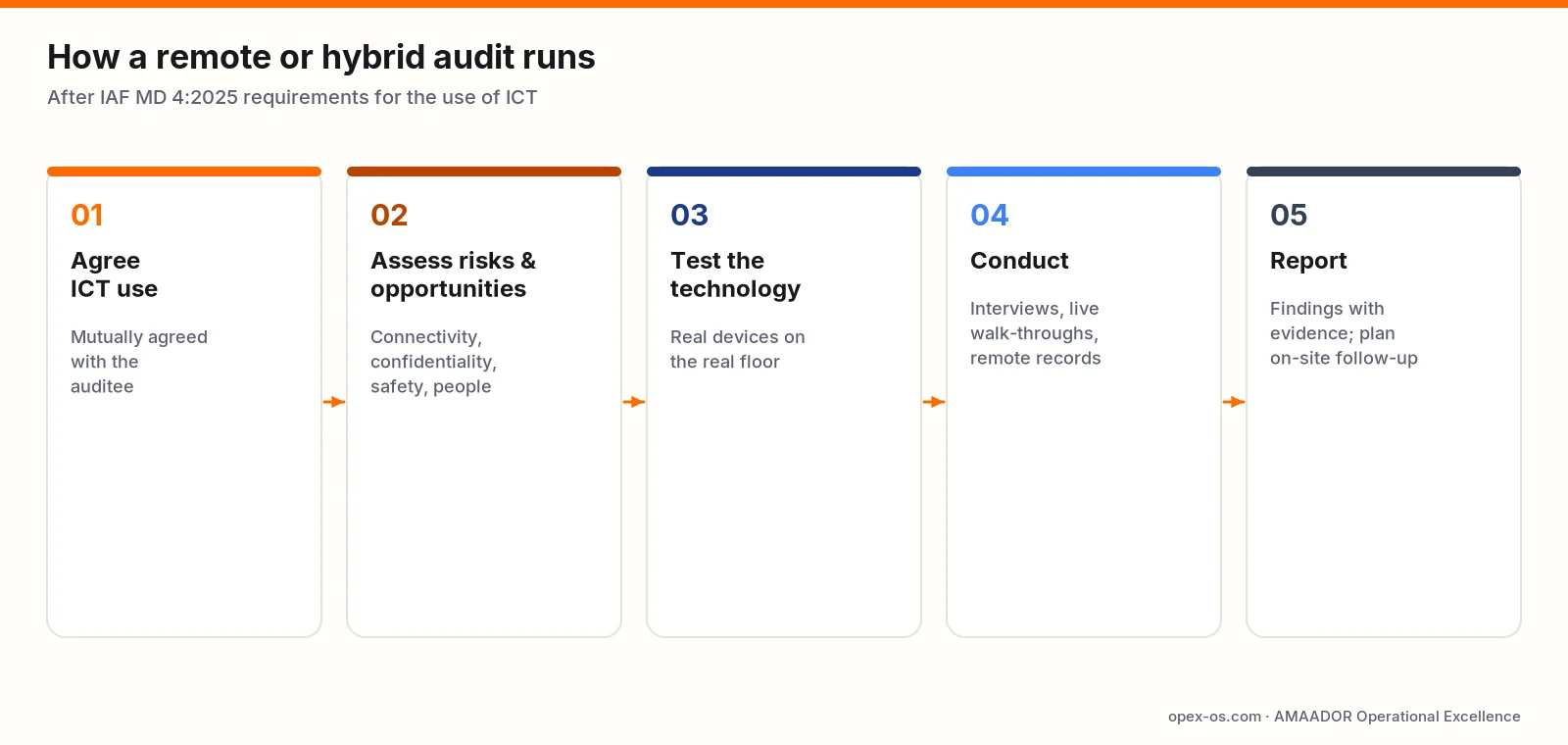
Key requirements include that the use of ICT shall be mutually agreed with the organization being audited, and that the body performing the assessment shall identify and document the risks and opportunities that may affect it, then plan how ICT will be used. IAF MD 4 also defines a virtual site, and notes that a virtual site cannot be considered where processes must be executed in a physical environment, such as warehousing or manufacturing. In other words, a factory floor cannot simply become a "virtual site".
What works remotely and what does not
| Audit activity | Remote suitability | Notes |
|---|---|---|
| Document and record review | High | Shared screens or secure access; agree sampling in advance |
| Interviews with managers and support staff | High | Video on; same questions as on site |
| Process walk-through on the floor | Medium | Live video with a guide; risk of seeing only what is shown |
| Observation of operators and conditions | Low to medium | Noise, safety and camera angles limit evidence |
| Hazardous or hard-to-reach areas | Medium to high | Video, drones or fixed cameras can improve access |
| Housekeeping, 5S, sensory checks | Low | Smell, sound, heat and the full picture are hard to judge remotely |
Indicative assessment; certification bodies decide case by case under IAF MD 4.
Pros and cons
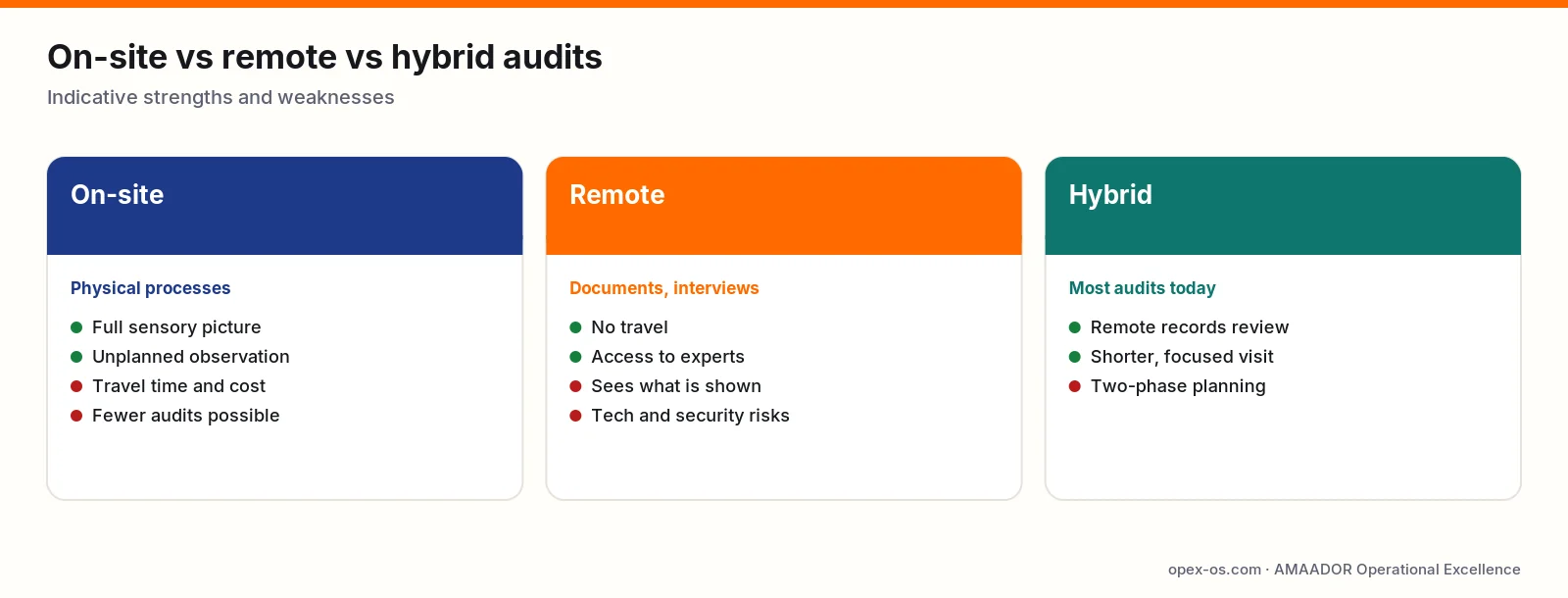
Pros: less travel time and cost, easier access to experts and to remote or hazardous areas, more frequent audits of suppliers and sites, and recorded evidence. Cons: limited view of real conditions, technical failures, confidentiality and security risks, fatigue in long video sessions, and weaker relationship building. Most organizations end up with hybrid audits: remote review of documents and records, followed by a shorter on-site visit focused on the floor.
The tools you need
- Video conferencing with screen sharing and reliable recording rules.
- Secure document sharing with time-limited access.
- Mobile video for walk-throughs: a phone or tablet on a stabilizer, or smart glasses for hands-free use, plus headsets in noisy areas.
- Audit management software or a structured checklist for findings, evidence and follow-up.
- Good connectivity on the floor, tested before the audit.
Remote audit checklist
- Agree in writing that ICT will be used and for which parts of the audit.
- Assess risks: connectivity, confidentiality, safety of filming, availability of people.
- Test the technology on the actual floor with the actual devices.
- Share the agenda, document requests and sampling plan in advance.
- Plan short sessions with breaks; long video calls reduce attention.
- For walk-throughs, ask the guide to show the area as a whole first, then specific points chosen by the auditor, not the auditee.
- Record evidence carefully and agree what can be recorded.
- Close with a summary and agreed actions, as on site.
Plan internal audits with our internal audit plan generator, use the audit checklist builder, and consider layered process audits for frequent short checks that complement remote audits.
Questions to ask before buying audit software
- Can auditors attach photos, video and documents to findings from a phone?
- Does it work offline and sync later?
- How are findings assigned, tracked and closed, with evidence of effectiveness?
- Can suppliers or sites respond to findings directly?
- How is confidential evidence protected and retained?
Supplier audits: where remote works best
Remote methods are particularly useful for supplier development. Instead of an annual visit, a buyer or quality engineer can hold shorter quarterly remote reviews of key processes, control plans, corrective actions and KPIs, saving visits for new suppliers, high-risk processes or persistent problems. Combine this with a supplier scorecard so remote reviews focus on the suppliers and processes with the weakest results. Be explicit with suppliers about what evidence you expect and how confidential documents will be handled.
Building auditor skills for remote work
Remote auditing needs different habits. Auditors should prepare sampling plans in advance, ask open questions that require showing evidence live, request wide camera views before close-ups, and keep sessions short with clear summaries. Pairing a remote lead auditor with an on-site colleague or a trusted site representative can improve coverage. Training should include the technology, confidentiality rules and how to spot when the view is being steered.
Common mistakes
- Treating a remote audit as a document review only.
- Letting the auditee control the camera and the route entirely.
- Skipping the technology test, then losing half the audit to connection problems.
- Recording without agreement, or sharing confidential material carelessly.
- Never returning on site for high-risk processes.
Related free tools
Sources and further reading
- IAF MD 4:2025, Issue 3: Use of ICT for Conformity Assessment Purposes (PDF)
- IAF: IAF publishes Issue 3 of IAF MD 4
Frequently asked questions
Are remote certification audits allowed?
What is IAF MD 4?
Can a manufacturing site be audited fully remotely?
What is a hybrid audit?
Put it into practice
Free calculators and procedure generators for maintenance, reliability and continuous-improvement teams.
Explore the free tools →