ISO 50001 Energy Management: How to Build Your EnMS
An energy audit finds savings once. An energy management system keeps finding them every year. ISO 50001 is the international standard for that system, and it follows the same Plan-Do-Check-Act logic as other ISO management standards. This guide explains the core concepts (energy review, significant energy uses, baselines and EnPIs), the free DOE 50001 Ready route, and what to prioritize in the first year.
What an energy management system is
The US Department of Energy (DOE) describes an Energy Management System (EnMS) as a set of practices that create a culture of continual improvement in energy performance, using quantitative tools that track energy use, inform decisions and help implement energy-saving practices. ISO 50001 specifies the requirements for such a system; its current edition is ISO 50001:2018.
The difference from an industrial energy audit is time. An audit is a snapshot that produces a list of opportunities. An EnMS is the routine that measures performance, assigns responsibility, and keeps generating and verifying improvements year after year. DOE states that participating sites typically achieve 4% annual energy savings year over year for more than a decade.
The PDCA structure
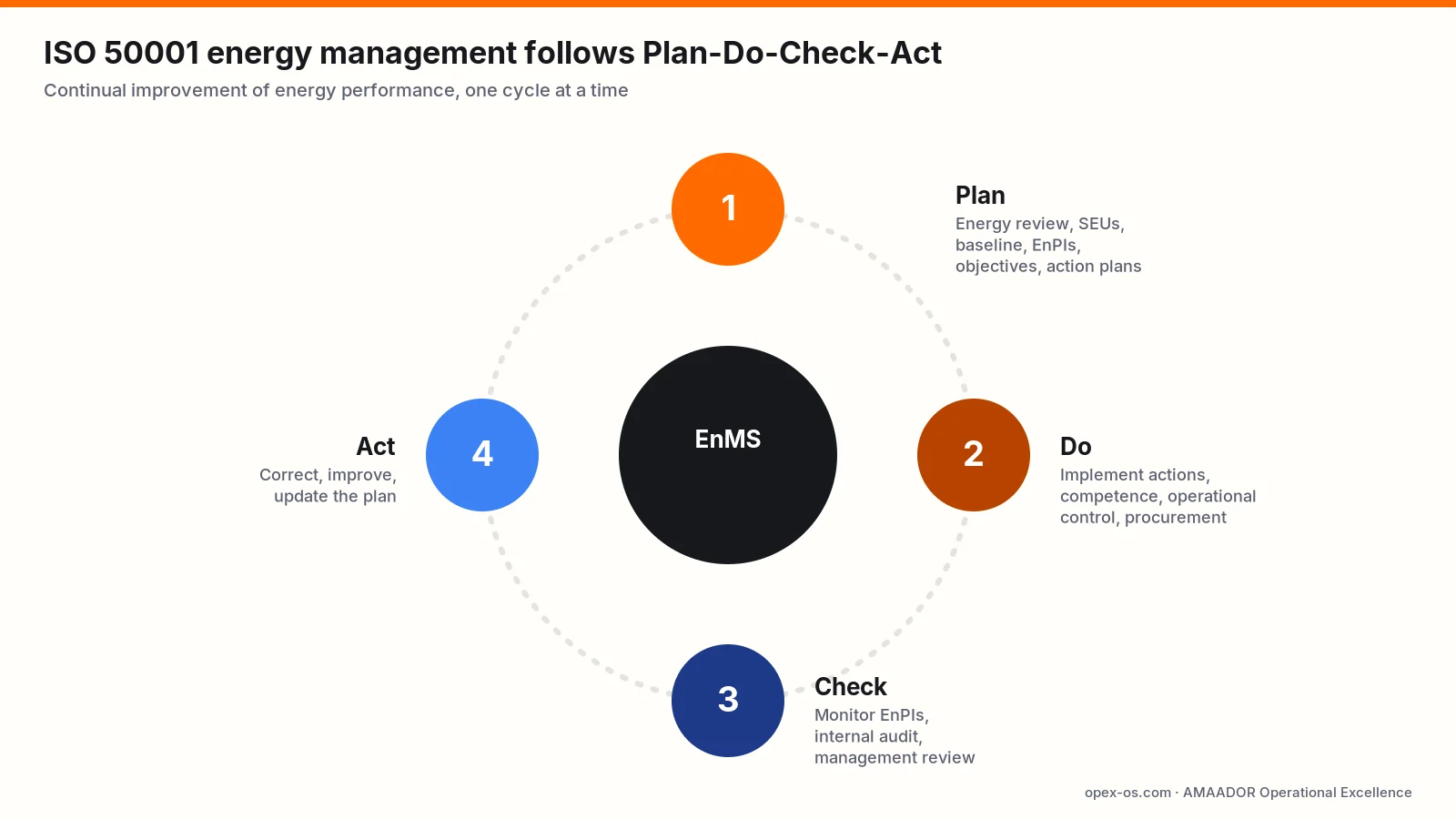
ISO 50001 uses the Plan-Do-Check-Act cycle common to ISO management system standards:
- Plan: understand context, set the energy policy and objectives, carry out the energy review, set baselines and indicators, and plan actions.
- Do: implement the action plans, build competence and awareness, control operations that affect energy, and consider energy in design and procurement.
- Check: monitor and measure energy performance, run internal audits and hold management reviews.
- Act: correct nonconformities and continually improve.
Top management commitment and a named energy team are what make the cycle turn. The free Energy policy and objectives check and Energy team charter check help you set those foundations.
The energy review
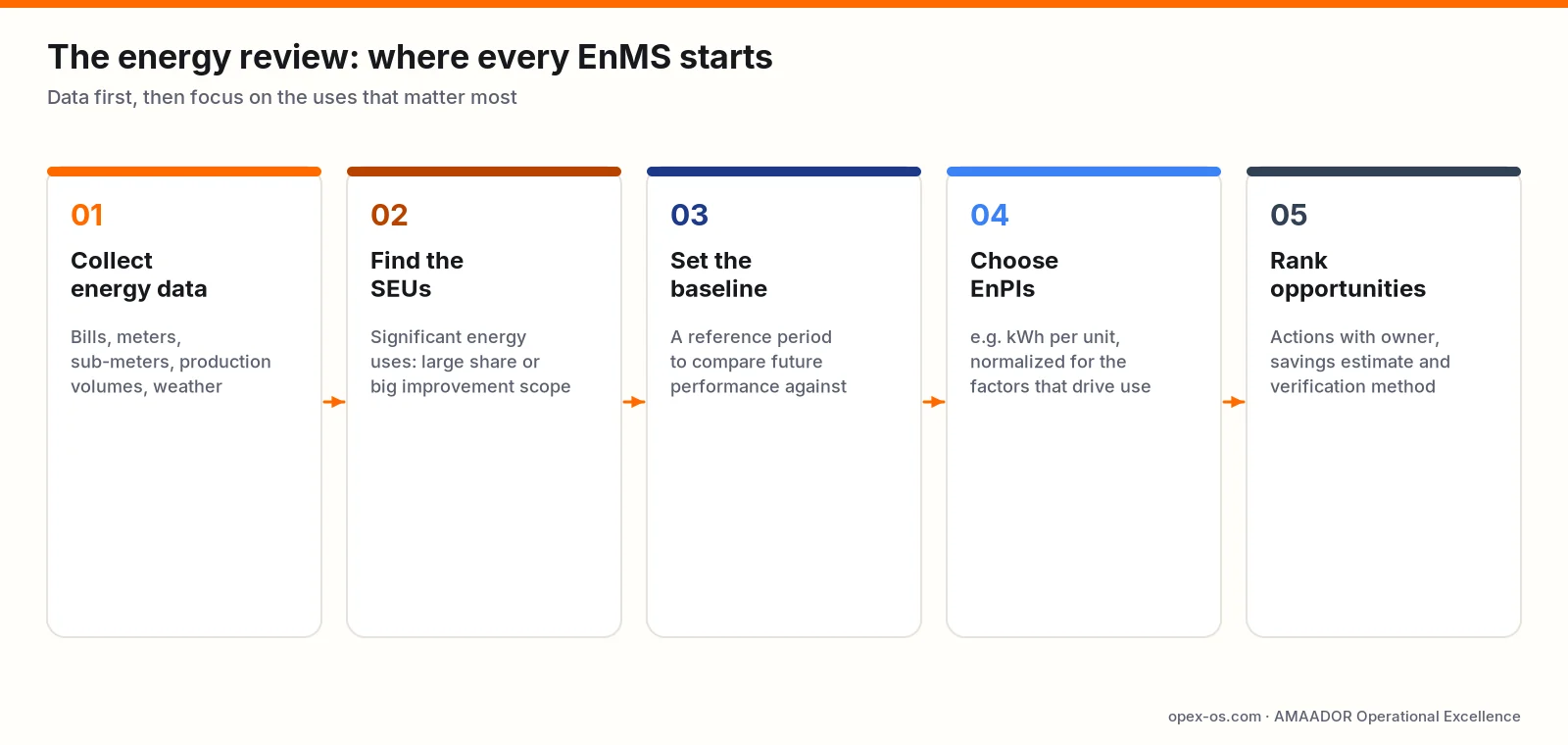
The energy review is the analytical heart of the system:
- Collect energy data: bills, main meters, sub-meters, and the variables that drive use, such as production volume, weather or occupancy.
- Identify Significant Energy Uses (SEUs): the uses that account for a large share of consumption or offer large potential for improvement; typically compressed air, process heating, HVAC, motors and pumps, or refrigeration.
- Identify the people and variables that affect each SEU.
- Determine improvement opportunities and rank them.
The free Energy consumption review tool gives you a structured way to do this from your own meter data.
Baselines and EnPIs
An energy baseline (EnB) is a reference period against which future performance is compared. An energy performance indicator (EnPI) is the measure you track, such as kWh per tonne or per unit produced. A raw kWh total is rarely a fair EnPI, because it rises and falls with production and weather. Normalizing for the relevant variables, often with a simple regression, lets you see whether performance really improved. The free Energy baseline and EnPI tool helps set this up.
Operational control: where savings live
Many energy savings come from how equipment is run, not from capital projects: shutting down compressors and HVAC when production stops, fixing compressed-air leaks, correct setpoints, and start-up sequences that avoid demand peaks. Write operating criteria for each SEU and check them. Idle load when the site is closed is a revealing first test: the paid Weekend Watt Hunt kit guides you through walking the site when it is closed, reading the meters, and calculating what the idle load costs per year with your own tariff. The free Compressed Air Leak Cost Calculator puts a number on one of the most common wastes.
The DOE 50001 Ready route
For organizations not ready for third-party certification, DOE runs 50001 Ready, which it describes as a self-paced, no-cost program that recognizes facilities and organizations that attest to implementing an ISO 50001-based energy management system, without requiring external audits or certification. DOE says the program breaks the standard's requirements into 25 steps, supported by the online 50001 Ready Navigator with guidance, examples and a progress dashboard, and that it prepares companies to pursue certification later if they choose.
Metering and measurement
You cannot manage SEUs you cannot measure. Main utility meters show the total; sub-meters on each SEU show where it goes. You do not need to meter everything at once: start with the largest SEUs, use portable loggers for short studies, and add permanent metering where the data will be used for control. Record the production and weather variables at the same intervals, so EnPIs can be normalized. The free baseline tool works with monthly data, which is often all a site has at the start.
Energy in design and procurement
ISO 50001 also asks organizations to consider energy performance when designing new or modified facilities and equipment, and when buying energy-using products and services. In practice, that means adding an energy section to project checklists and purchasing specifications, and comparing life-cycle energy cost, not just purchase price, for motors, compressors, chillers and lighting. These decisions lock in energy use for many years, so they often matter more than any single operational fix.
Certification or not?
Third-party certification to ISO 50001 provides external assurance that customers, investors or regulators may value. Many organizations start with a self-declared system, or with DOE's 50001 Ready recognition, build the routine and the data, and certify later. What matters most for energy cost is that the cycle actually turns: reviews happen, EnPIs are read, and actions are completed and verified.
First-year priorities
- Secure top management commitment, an energy policy and a named energy team.
- Complete a first energy review and identify the SEUs.
- Set a baseline and one or two normalized EnPIs per SEU.
- Build an action plan with owners, savings estimates and a verification method; the free Energy action plan register helps keep it current.
- Put operational controls in place for each SEU.
- Hold the first management review with real EnPI data.
Common mistakes
- Writing the manual first and measuring later.
- Using unnormalized kWh, so a busy month looks like failure.
- An energy team with no authority over operations or procurement.
- Projects only: ignoring operational control, where many low-cost savings are.
Related free tools
Sources and further reading
Frequently asked questions
What is ISO 50001?
What is a significant energy use (SEU)?
What is an EnPI?
What is DOE 50001 Ready?
Put it into practice
Free calculators and procedure generators for maintenance, reliability and continuous-improvement teams.
Explore the free tools →