Idea Management Software for Continuous Improvement
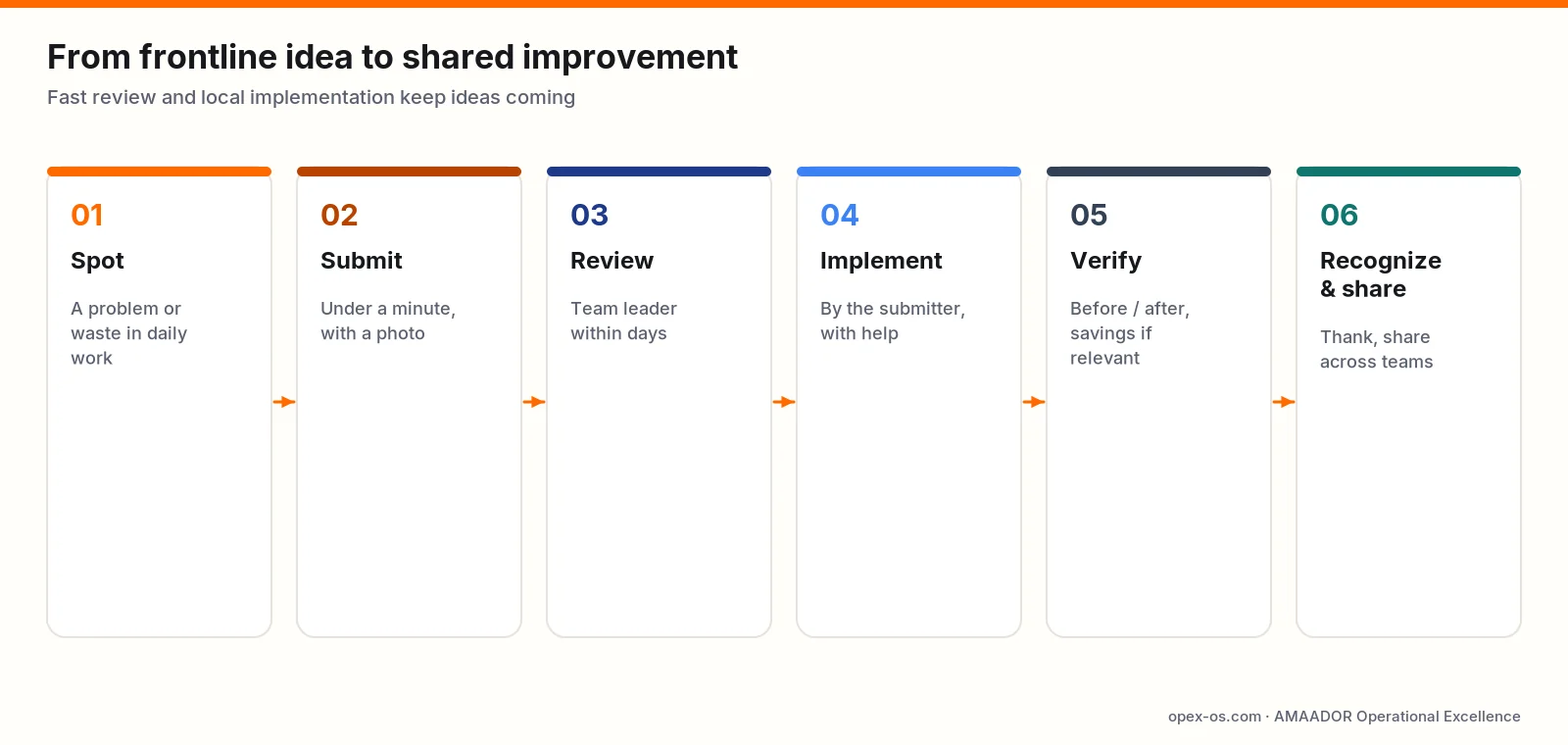
Every frontline employee sees small problems that managers miss. An idea system turns those observations into improvements, if ideas are reviewed quickly, implemented by the people closest to the work, and recognized. Software can help or hinder. This guide draws on Toyota’s long-running suggestion system, compares paper, board and software options, and sets out selection criteria and KPIs.
Lessons from Toyota’s suggestion system
Toyota's own history records that Managing Director Shoichi Saito, after training at Ford's River Rouge plant, introduced a suggestion system based on Ford's in order to gather ideas from a wide range of employees. Called the Creative Idea Suggestion System, it began operating in May 1951 and has been improved and expanded over time.
A 1973 Toyota press release gives a sense of scale and of what changed. The program attracted 789 ideas in its first year. In 1973 it expected more than 250,000 suggestions from about 43,000 employees, with more than 70% adopted. The share of adopted suggestions rose from 29% in 1956 to 76% in 1972, which Toyota attributed to a carefully devised submittal procedure, monthly themes such as maintenance or quality, and plant subcommittees that focused creative thinking on specific problem areas. Statistics and news on the program were shared with employees every month.
The lessons still apply: make it easy to submit, focus ideas on real problems, review fast, implement most ideas, and communicate results.
Options compared
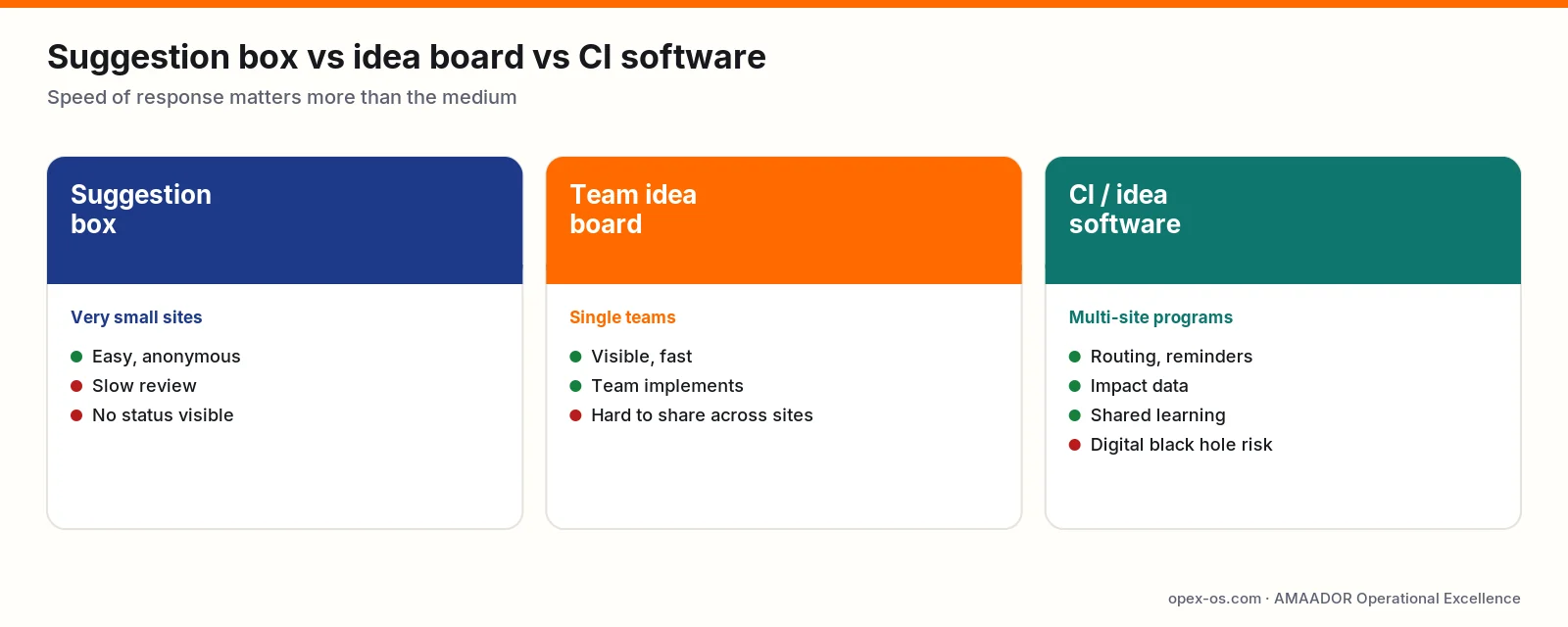
| Criterion | Suggestion box or form | Idea board at the team area | CI or idea management software |
|---|---|---|---|
| Ease of submission | Easy, anonymous | Easy, visible | Easy on mobile; needs access |
| Speed of review | Often slow; boxes emptied monthly | Fast: reviewed in team meetings | Fast with routing and reminders |
| Who implements | Often "management" | The team | Assigned owner, often the submitter |
| Visibility of status | None | High within the team | High across the site |
| Measuring impact | Rarely | Manual counts | Savings, categories, participation |
| Best for | Very small sites | Single teams, tier 1 | Multi-team, multi-site programs |
Indicative comparison of approaches, not of specific products.
Pros and cons of software
Pros: mobile submission, routing to the right reviewer, reminders, status visible to the submitter, shared learning across sites, and data on participation and impact. Cons: licences and administration, the risk of a digital black hole if reviews are slow, and a temptation to manage ideas by dashboard instead of in team meetings. A board in the team area and a weekly review can outperform software if the team acts.
Selection criteria
- Submission in under a minute on phone, kiosk or tablet, in local languages, with photos.
- Routing to the team leader first, with escalation if no response within a set time.
- Simple workflow: submitted, accepted, in progress, done, verified.
- Link to daily management so ideas are reviewed in tier meetings.
- Impact tracking: safety, quality, cost, time, with validated savings where relevant.
- Recognition features and sharing of good ideas across teams.
- Links to A3s, kaizen events and project portfolios for bigger ideas.
The video is a vendor overview of continuous improvement software, included to illustrate typical features, not as an endorsement.
Designing the system
- Ask for ideas the submitter can implement, with help, rather than wishes for others.
- Review within days at the team level; most small ideas need no committee.
- Use monthly themes, as Toyota did, to focus attention on current problems.
- Record before and after, with photos, so improvements are visible and shareable.
- Validate savings for larger ideas with the savings validation template.
- Review ideas with the kaizen idea review generator and escalate bigger ones to a kaizen charter or kaizen event.
KPIs that matter
- Ideas implemented per person per year, not just submitted.
- Median days from submission to first response and to implementation.
- Participation: share of employees with at least one implemented idea.
- Impact by category: safety, quality, delivery, cost.
Questions to ask vendors
- Show submission on a phone in under a minute, with a photo.
- What happens when a reviewer does not respond?
- How do ideas appear in team meetings?
- How are savings validated and reported?
- How are good ideas shared across sites?
Cost and value
Software costs licences, administration and time to configure workflows and categories. The value comes from more implemented improvements, faster response to ideas, and shared learning across teams and sites. A team idea board costs almost nothing and is often the best place to start. Move to software when ideas need to cross team boundaries, when several sites want to share improvements, or when leaders need reliable data on participation and impact. Validate claimed savings for larger ideas so the program keeps credibility with finance.
The leader's role
Idea systems live or die by first-line leaders. They must respond quickly, help people implement their own ideas, remove obstacles and give recognition. Build idea review into the team leader's standard work, for example a short weekly review at the team board, and track response times by team. Senior leaders should visit teams to see implemented ideas, ask about them and share the best ones widely. When leaders treat small ideas as seriously as big projects, people notice, and participation grows.
Common mistakes
- Slow reviews: nothing kills an idea system faster.
- Large cash rewards that encourage gaming and arguments, instead of recognition and implementation.
- Ideas sent to engineering backlogs that never move.
- Counting submissions instead of implemented improvements.
Related free tools
Sources and further reading
- Toyota (1973 release): Toyota company suggestion program vigorously supported by employees
- Toyota 75 Years: training at Ford and the Creative Idea Suggestion System
- Lean Enterprise Institute: Kaizen
Frequently asked questions
When did Toyota start its suggestion system?
What makes an idea system successful?
Do we need software for idea management?
Should we pay for ideas?
How quickly should ideas get a response?
What kinds of ideas should a system encourage?
Put it into practice
Free calculators and procedure generators for maintenance, reliability and continuous-improvement teams.
Explore the free tools →